CyberGhost vs Surfshark 2026: Which VPN Is Better?
CyberGhost vs Surfshark in 2026: price, 7 vs unlimited devices, specialty servers, CleanWeb, refunds, and Deloitte audits. No invented speed tests.
Picking between CyberGhost and Surfshark feels like choosing two budget tickets to the same city.
Both advertise servers in 100 countries, WireGuard support, kill switches, and Deloitte-backed no-logs claims. Both sell a cheap first term and a sharper renewal.
The useful question isn’t “which logo is better.” It’s which limit will actually bite you: seven devices or a shorter refund window, labelled specialty servers or unlimited connections, a Romania HQ or a Netherlands one.
This CyberGhost vs Surfshark comparison sticks to official pricing, feature, and audit pages checked on October 5, 2026. We haven’t run fresh speed or streaming tests for this post, so every claim below is sourced or clearly labelled as our take.


- CyberGhost’s longest intro deal is cheaper on paper; Surfshark wins when you need more than seven devices.
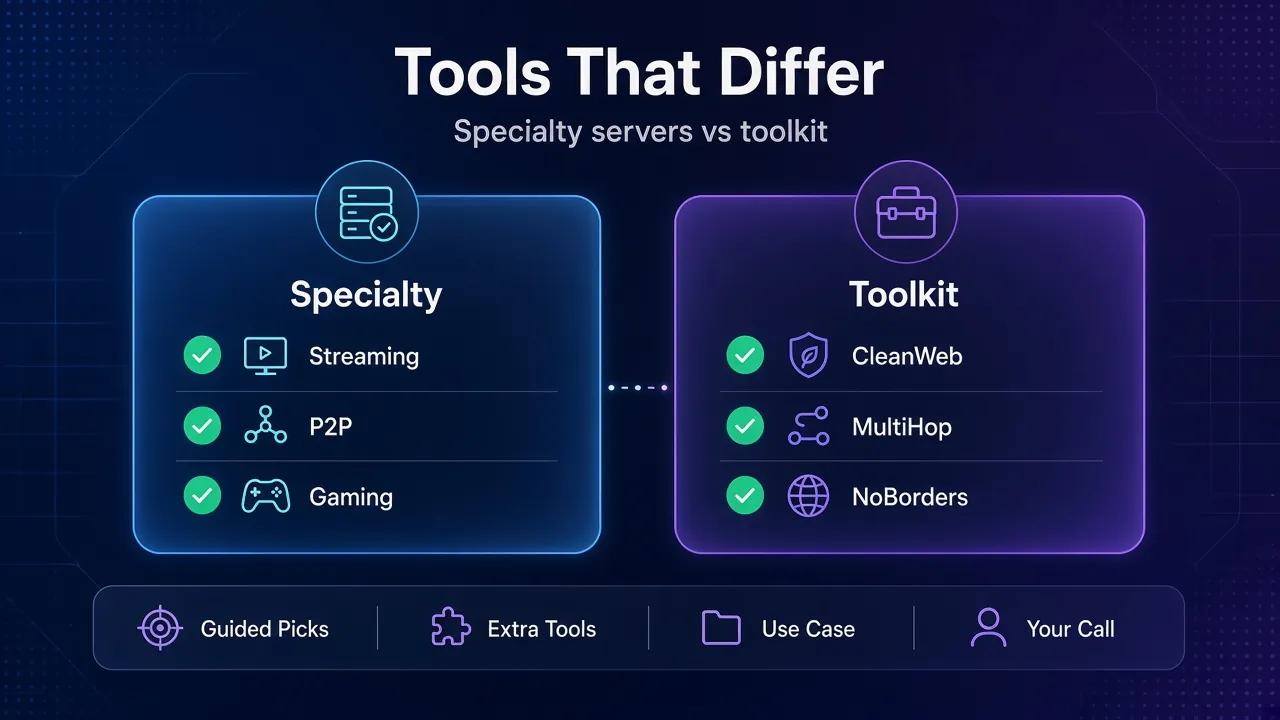
- CyberGhost labels streaming, P2P, and gaming servers; Surfshark leans on CleanWeb, MultiHop, and NoBorders.
- Both publish Deloitte no-logs assurance. CyberGhost offers the longer refund window.
- We compared published specs only. No invented speed or Netflix scores.
How We Compared CyberGhost and Surfshark
Every plan price, device limit, country count, refund window, and audit claim in this post comes from an official page opened on October 5, 2026. When a checkout page and a marketing page disagreed on a soft number (CyberGhost’s server count is the main example), we say so.
Our take: treat directory cards as a starting point, then re-check the live checkout before you pay. Cards can lag. Today CyberGhost’s directory card still shows $2.03/mo while the homepage lists $2.19/mo on the 26-month deal, and Surfshark’s card shows $2.19/mo while Starter’s long plan lists $2.49/mo.
We may earn a commission if you buy through our links. That never changes the sourced numbers or the verdict logic.
The Contenders at a Glance
1CyberGhost
CyberGhost is the beginner-friendly pick with labelled specialty servers for streaming, P2P, and gaming, a Romania headquarters, and a long refund window on multi-month plans. One subscription covers up to seven devices at once.
2Surfshark
Surfshark is the household and toolkit pick: unlimited simultaneous connections, CleanWeb, Dynamic MultiHop, NoBorders, and optional One / One+ bundles. It’s run by Surfshark B.V. in Amsterdam.
Browse both in our VPN directory, or line them up in the compare tool.
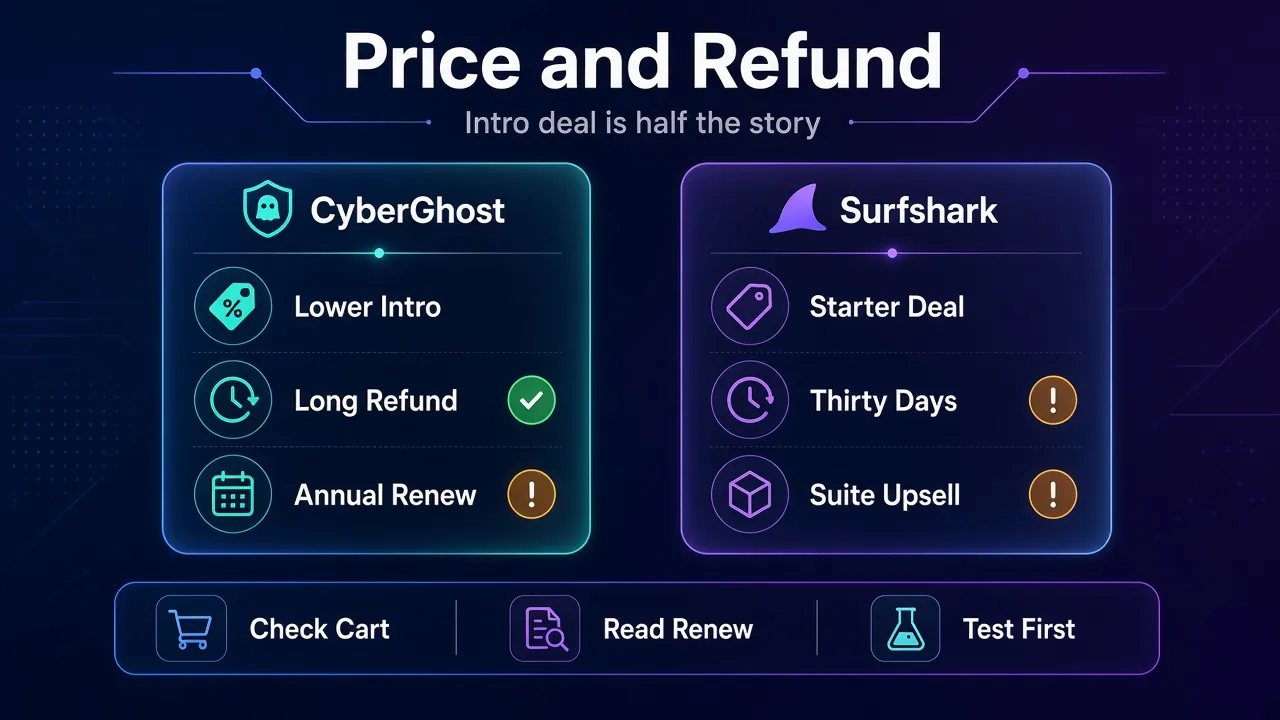
Pricing: Who Costs Less on Day One?
Both brands sell a steep intro discount and autorenew later. Here’s what the live pages showed on October 5, 2026.
| Plan | CyberGhost | Surfshark Starter |
|---|---|---|
| Longest intro | $2.19/mo for 26 months ($56.94 first term, then $56.94/year) | $2.49/mo ($67.23 for the first 27 months) |
| Mid term | $6.99/mo billed $41.94 every 6 months | $3.39/mo on 12 months |
| Month to month | $12.99/mo | $16.45/mo |
| Money-back | 45 days (long plans); 14 days (monthly) | 30 days |
CyberGhost wins the cheapest published intro rate and the longer refund window. Surfshark Starter costs a little more up front, then branches into One ($2.79/mo long) and One+ ($4.49/mo long) if you want antivirus, Alert, scam protection, or Incogni.
Check before you buy: Surfshark’s pricing FAQ says the two-year plan bills once up front and then annually at the applicable renewal price. CyberGhost’s homepage states the 26-month deal autorenews at $56.94 annually. Read the fine print on the day you check out. For a deeper Surfshark breakdown, see our Surfshark pricing guide.
A quick worked example with the published first-term totals: CyberGhost’s 26-month cart is $56.94. Surfshark Starter’s long cart is $67.23. That’s about $10 more for Surfshark before either renewal hits. Spread across unlimited devices, that gap is small. Spread across one laptop, CyberGhost keeps the cash.
Surfshark One and One+ change the comparison if you were going to buy antivirus or data-removal tools anyway. If you only need a tunnel, compare Starter to CyberGhost and ignore the suite upsell.
Devices: Seven Caps vs Unlimited
This is the cleanest structural difference in the whole comparison.
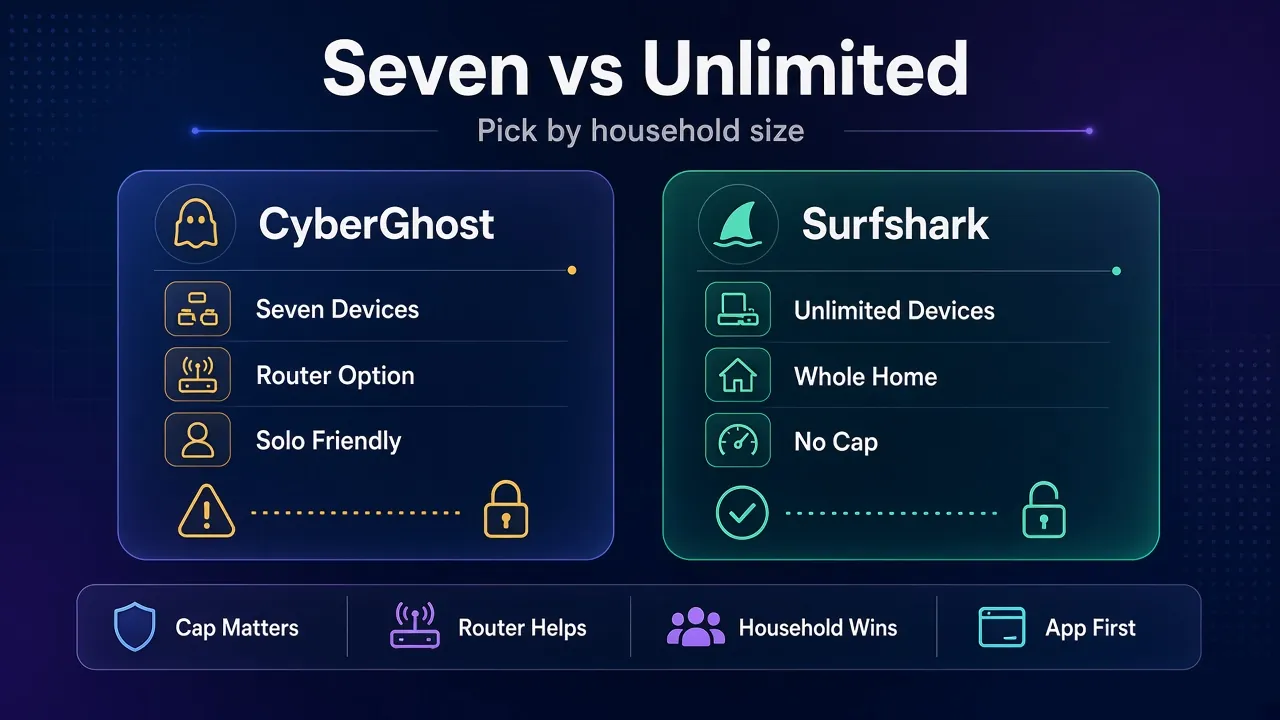
CyberGhost’s homepage and features page both cap simultaneous connections at seven. A compatible router counts as one connection and can cover the rest of the household behind it.
Surfshark’s features page and pricing FAQ both promise unlimited simultaneous connections on a paid plan. The free trial is limited to three devices until it ends.
Our take: solo users and couples rarely feel CyberGhost’s seven-device cap. Families, shared flats, or anyone who VPNs phones, laptops, a TV stick, and a tablet at once will feel it immediately. Unlimited is Surfshark’s best argument, and it isn’t subtle.
There’s a common workaround on both sides: install the VPN on a compatible router. That usually counts as one connection and covers every device on that Wi-Fi. It also means more setup, firmware luck, and a single point of failure. If you want “open the app and connect” on eight phones, Surfshark still wins without the networking homework.
Servers and Specialty Locations
Both market servers in 100 countries. The shape of the networks differs.
- Surfshark: 4,500+ RAM-only servers, with pricing copy stating 10 Gbps upgrades across the fleet.
- CyberGhost: servers in 100 countries on the homepage and transparency fleet report; the US checkout page lists “9800+ VPN Servers.” Country coverage is the number both sides publish consistently.
CyberGhost’s features page highlights labelled streaming, P2P, and gaming specialty servers. That matters if you want the app to point you at a purpose-built endpoint instead of guessing.
Surfshark doesn’t lean on the same three-way specialty list. It leans on fleet size plus tools like MultiHop and obfuscated / NoBorders servers when the normal path is blocked.
Round verdict: CyberGhost for guided specialty picks; Surfshark for raw connection flexibility and restricted-network tooling. Country count is a tie; the labelled specialty list is not.
Features Round: CleanWeb, MultiHop, and Specialty Tools
Security basics look similar on paper: AES-class encryption, WireGuard / OpenVPN / IKEv2 options, kill switch, split tunneling, and RAM-only servers.
Where they diverge:
- Surfshark CleanWeb blocks ads, trackers, and malicious sites. CyberGhost’s closest match is its Content Blocker for ad, tracker, and malware domains.
- Surfshark Dynamic MultiHop routes traffic through two servers with manual entry and exit picks.
- Surfshark NoBorders plus obfuscated servers target restricted networks. CyberGhost’s public features pages don’t market an equivalent mode under that name.
- Surfshark Rotating IP (Nexus) changes the IP on a timer without dropping the tunnel; the plans blog notes macOS availability for that rotator.
- CyberGhost specialty servers remain the clearer one-click path for streaming, torrenting, and gaming categories.
- Both sell a Dedicated IP add-on. Surfshark lists 20 locations on the pricing page.
If you want a bundle, Surfshark One adds Antivirus, Alert, and scam protection; One+ adds Incogni. CyberGhost’s core plans stay closer to “VPN first,” with optional add-ons like Dedicated IP and Security Suite on checkout.
Both advertise an automatic kill switch. Confirm it is enabled after install, especially on mobile networks that drop often.
Privacy, Audits, and Jurisdiction
Both publish no-logs policies and point to Deloitte assurance under ISAE 3000.
- CyberGhost: Deloitte Audit Romania reviews in 2022 and 2024, plus a third engagement covered on its privacy hub (report page last updated February 24, 2026). Headquarters: Romania.
- Surfshark: Deloitte no-logs assurance in 2023 and again in 2025 (announced June 16, 2025). Company: Surfshark B.V., Amsterdam, Netherlands.
Neither audit is a lifetime guarantee. They are point-in-time reviews of systems and policy claims. Read the published summaries, and prefer providers that keep inviting auditors back.
Round verdict: privacy is close enough that jurisdiction preference and audit cadence matter more than a slogan. CyberGhost currently advertises the longer Deloitte Romania streak; Surfshark pairs Dutch incorporation with recent Deloitte and other trust-center materials.
A VPN also doesn’t erase every tracker. Cookies, logins, and GPS can still place you. For that nuance, see does a VPN hide your location. Primary audit write-ups: CyberGhost’s third Deloitte Romania no-logs review and Surfshark’s 2025 Deloitte assurance post.
Streaming, Torrenting, and Everyday Use
We will not invent Netflix region scores for either brand.
What the official pages do say: CyberGhost markets streaming-optimized, P2P-optimized, and gaming-optimized servers. Surfshark markets a large general fleet, CleanWeb during playback, and apps for Android TV, Apple TV, and Fire TV alongside desktop and mobile.
Practical advice: pick the VPN whose refund window you prefer, test the exact library or torrent site you care about in the first week, and keep notes. If it fails, refund. That beats trusting an undated “works with Netflix” claim from any blog, including ours.
If streaming is the whole job, spend the first refund week on the exact catalogs you care about rather than a generic “works with Netflix” claim.
Trials, Support, and Getting Started
CyberGhost’s homepage FAQ lists short free trials: 24 hours on Windows and macOS, three days on Android, and seven days on iOS, plus the 45-day (or 14-day monthly) money-back window.
Surfshark’s plans blog describes a seven-day trial through the Apple App Store or Google Play (12-month option), and treats the 30-day money-back guarantee as the risk-free path for website purchases.
Both advertise 24/7 live chat. App coverage overlaps heavily: Windows, macOS, Android, iOS, Linux, Fire TV / Android TV / Apple TV, plus browser extensions and router setups.
Active promo carts can beat the sticker price on either side. Compare the final checkout total, not the marketing tile, before you commit.
What Most CyberGhost vs Surfshark Posts Get Wrong
Three traps show up again and again in competing roundups.
First, undated speed charts. A 2024 Mbps table tells you almost nothing about tonight’s WireGuard hop. We skipped inventing one.
Second, recycled Camouflage Mode claims. CyberGhost’s old Camouflage URL returned 404 when we checked it on October 5, 2026, so this post does not treat it as a current feature.
Third, ignoring renewal math. CyberGhost’s homepage prints the $56.94 annual renewal on the 26-month tile. Surfshark’s pricing FAQ says the long plan renews annually at the applicable renewal price. The first-year screenshot is only half the story.
If you want a second opinion in the same house style, our NordVPN vs Surfshark comparison uses the same sourced approach for a different rival pair.
CyberGhost vs Surfshark: Full Comparison Table
| Criterion | CyberGhost | Surfshark | Edge |
|---|---|---|---|
| Longest intro price | $2.19/mo (26 months, $56.94) | $2.49/mo Starter ($67.23 / 27 months) | CyberGhost |
| Monthly price | $12.99 | $16.45 Starter | CyberGhost |
| Money-back | 45 days / 14 days monthly | 30 days | CyberGhost |
| Simultaneous devices | 7 | Unlimited | Surfshark |
| Countries | 100 | 100 | Tie |
| Published server claim | 9,800+ on checkout; 100 countries on homepage | 4,500+ | CyberGhost (count claim) |
| Specialty servers | Streaming, P2P, Gaming | General fleet + MultiHop / obfuscated | CyberGhost (labels) |
| Ad / tracker blocker | Content Blocker | CleanWeb | Surfshark (broader toolkit) |
| Restricted networks | Not marketed as NoBorders | NoBorders + obfuscated | Surfshark |
| HQ | Romania | Netherlands | Preference |
| Deloitte no-logs | 2022, 2024, third review | 2023, 2025 | Close |
| Suite extras | Add-ons on checkout | One / One+ bundles | Surfshark |
Who Should Pick Which?
| Your situation | Pick | Why |
|---|---|---|
| You need more than seven devices online at once | Surfshark | Unlimited simultaneous connections |
| You want the cheapest published intro and a long refund | CyberGhost | $2.19/mo deal + 45-day window |
| You want labelled streaming / P2P / gaming servers | CyberGhost | Specialty categories in-app |
| You travel through restrictive networks | Surfshark | NoBorders + obfuscated servers |
| You want antivirus / Alert / Incogni in one bill | Surfshark One or One+ | Published bundles |
| You’re a solo user who mostly streams | CyberGhost | Price + specialty servers |
| You’re comparing against NordVPN too | Read next | Use the same sourced method on that rival pair after this one |
Use the table as a filter, not a scoreboard. If two rows both point at the same VPN for your life, stop shopping and test that one during the refund window.
Frequently Asked Questions
Final Verdict: Which VPN Should You Choose?
Our take: pick Surfshark if anyone in your house will blow past seven simultaneous connections, or if you want CleanWeb, MultiHop, and NoBorders without stacking extra tools. Pick CyberGhost if you want the cheaper published intro, a 45-day refund on long plans, and specialty servers that say streaming, P2P, or gaming on the tin.
Neither choice is a trap on paper. Both are audited no-logs VPNs with real apps and real refund windows. The wrong choice is paying for a two-year plan before you’ve tested the one library or device mix you actually care about.
Next step: open both live pricing pages, compare the cart totals for the term you’d actually keep, then start the shorter commitment or lean on the money-back window. If Surfshark renewals are the worry, read the renewal line on the checkout screen before the intro glow fades.