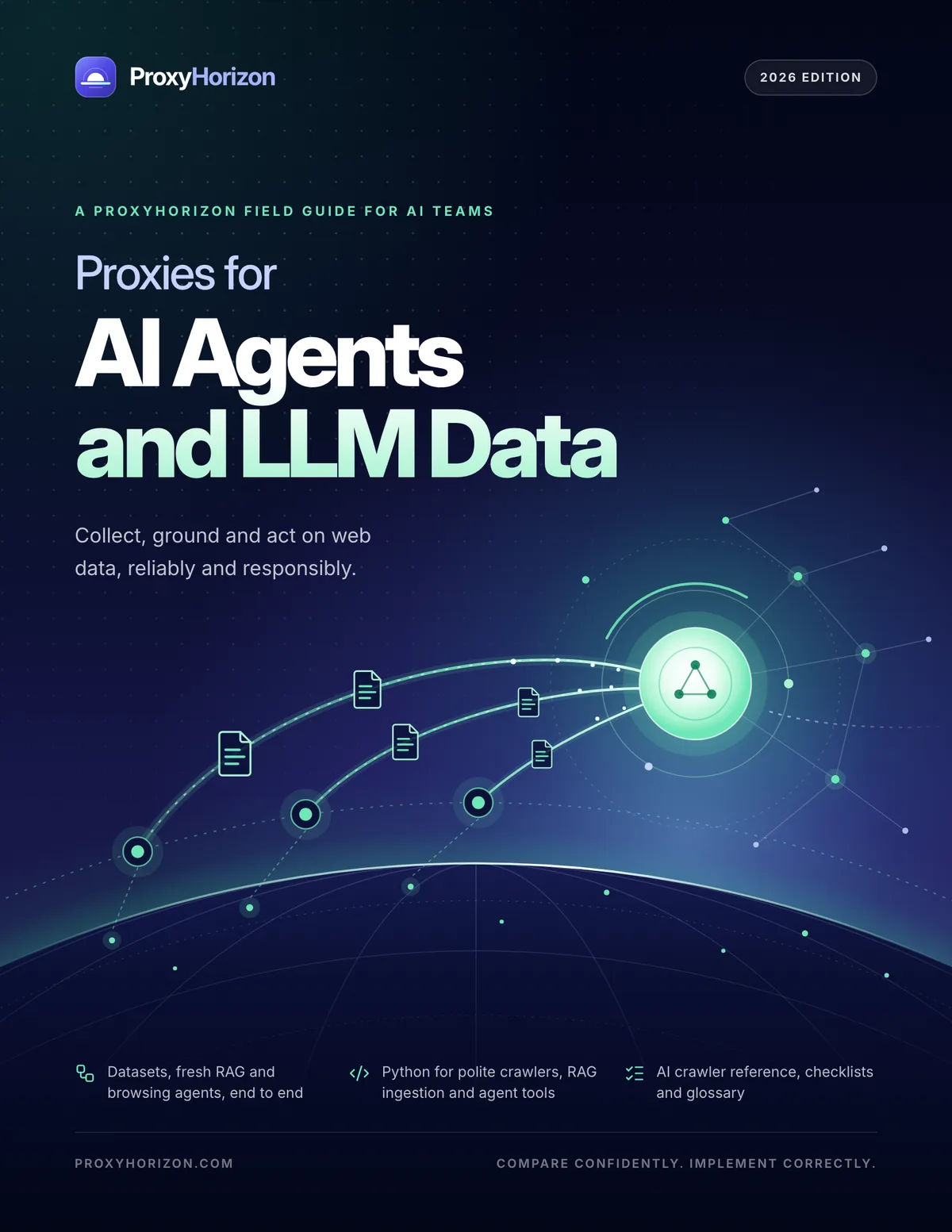
Proxies for AI Agents and LLM Data
The free guide to collecting, grounding and acting on web data for AI, reliably and responsibly.
- Eleven chapters on datasets, RAG, agents, security, cost and compliance
- Copy-ready Python for polite crawlers, RAG ingestion and agent tools
- An AI crawler reference, checklists and a glossary
PDF · 59 pages · 6.4 MB · No sign-up needed
- Pages
- 59
- Chapters
- 11
- Diagrams
- 25
- Tables
- 22
- Code examples
- 12
About the eBook
Everything you need to build the web-data layer of an AI product
Every AI product that reads the live web has a data layer, whether anyone designed it or not. Proxies for AI Agents and LLM Data shows you how to design it on purpose: where training data, RAG sources and agent browsing should come from, how pages move through an eleven-stage pipeline, and where proxies help and where they don't.
It's written for engineers and the people who fund them, with copy-ready Python for polite crawling, Markdown ingestion, a safe agent page-fetching tool and an SSRF guard, plus the security, cost and compliance chapters that keep it all running. Provider figures come from the ProxyHorizon directory, and AI crawler details were checked against each operator's own documentation.
Your model is only as good as the pages it reads, and only as safe as the way it reads them.
By the end, you'll be able to
- Map your product's web-data needs to build, ground and act, and pick the cheapest legitimate source for each
- Design a pipeline from discovery to evaluation, knowing what each stage costs and how it fails
- Choose proxy types, session strategies and pool sizes for crawlers and for agents
- Build training sets and RAG indexes that are clean, deduplicated, fresh and citable
- Give agents a browser with one identity per task, hard budgets and human approval where it counts
- Defend against prompt injection and SSRF, and collect data in line with copyright, privacy and AI rules
Look inside
Real pages from the eBook
Diagrams of real pipelines, tables you can decide from and Python you can adapt. Select any page to see it full size.
What's inside
11 chapters, from first crawl to compliant production
Read it front to back once, then keep it open as a reference. Every chapter ends with key takeaways.
- 01p. 5
Why AI Runs on Web Data
Three jobs, build, ground and act, and where proxies fit in each.
- 02p. 9
The AI Data Pipeline, End to End
Eleven stages from URL to answer, with the cost and failure points of each.
- 03p. 14
Proxy Fundamentals for AI Workloads
Proxy types mapped to AI jobs, sessions, concurrency and bandwidth math.
- 04p. 18
Building Training and Fine-Tuning Datasets
Open corpora first, then polite crawling, quality filtering, dedupe and documentation.
- 05p. 24
Fresh Data for RAG
Clean Markdown, chunking, metadata, recrawl schedules and citations.
- 06p. 29
Giving Agents a Browser
One identity per task, isolation, budgets, approval gates and a safe page-fetching tool.
- 07p. 35
Treat the Web as Untrusted Input
Prompt injection, SSRF and secrets, with a threat-to-mitigation map.
- 08p. 39
Geo, Localization and AI Visibility
Why AI answers change by country, and how to track your brand inside them.
- 09p. 43
Throughput, Reliability and Cost
The metrics, levers and cost math that keep AI data pipelines lean.
- 10p. 47
Choosing Providers for AI Teams
AI-specific criteria, nine networks worth testing and when to buy instead of build.
- 11p. 51
Responsible AI Data Collection
Copyright, the EU AI Act, privacy, opt-outs, provenance and takedowns.
- Ap. 55
Appendix
An AI crawler reference, a collection checklist, a glossary and free tools.
Who it's for
Written for the people building AI on web data
AI engineers and agent builders
Proxy choices, per-task identities, budgets and guardrails, with working code for browsing agents.
Data teams building RAG
Clean Markdown, chunking, metadata and recrawl schedules that keep an index fresh and citable.
Founders, SEO and marketing teams
What the data layer costs, which vendors to trust, where the legal lines are and how AI assistants describe your brand.
FAQ
Questions, answered
Is the eBook really free?
Yes. There's no sign-up and no email gate: download the PDF and start reading. You're welcome to share it with your team, unchanged and with credit.
Who is it for?
AI and ML engineers, agent builders and data teams building RAG, plus founders of AI products and SEO or marketing teams tracking how AI assistants mention their brand. It assumes you know what an LLM is.
Do I need to know proxies already?
It helps but isn't required. The book recaps what AI workloads need and points to The Ultimate Proxy Handbook, ProxyHorizon's free guide to proxy fundamentals, for the rest.
Is the legal chapter legal advice?
No. It's a plain-English overview of EU text and data mining rules, the EU AI Act's duties for general-purpose AI models, privacy law and terms of service, checked against official sources. For anything high-stakes, talk to a lawyer.
Is it vendor-neutral?
Yes. ProxyHorizon is independent. The provider chapter lists nine networks in alphabetical order using figures from the ProxyHorizon directory, and the eBook contains no affiliate links.
What format is it in?
A 59-page PDF of about 6.4 MB, across 11 chapters, with clickable links and a bookmark for every chapter and section. It's designed for reading on screen and prints cleanly on US Letter or A4.
How current is it?
This is the 2026 Edition. Provider figures come from the ProxyHorizon directory and AI crawler details from each operator's own documentation, both checked in November 2026. Prices change often, so check the directory for live numbers.
More free eBooks
All eBooks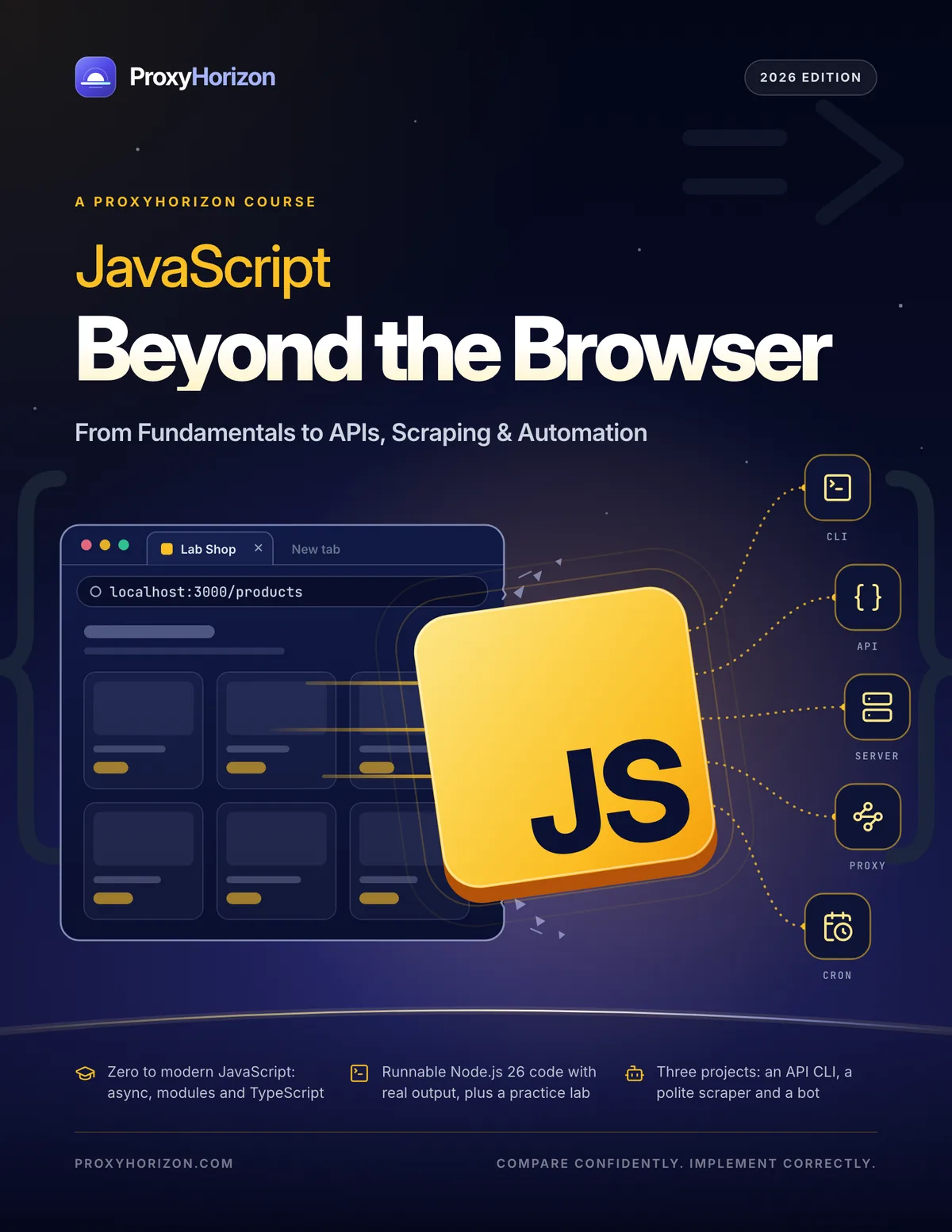
123 pages · Free PDF
JavaScript Beyond the Browser
The free course that takes you from your first line of JavaScript to APIs, scrapers and automation bots.
Read more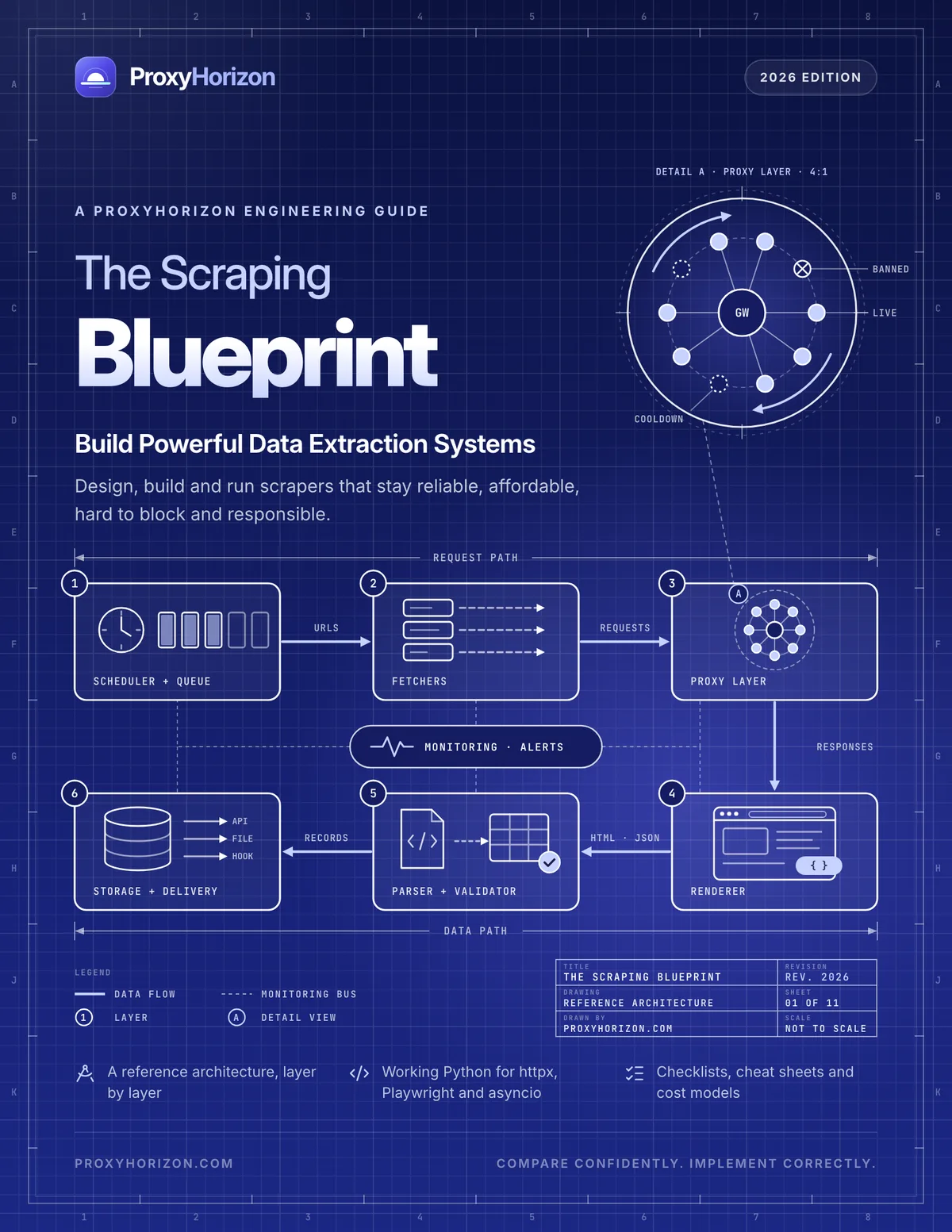
60 pages · Free PDF
The Scraping Blueprint
The free engineering guide to building scraping systems that stay reliable, affordable and unblocked.
Read more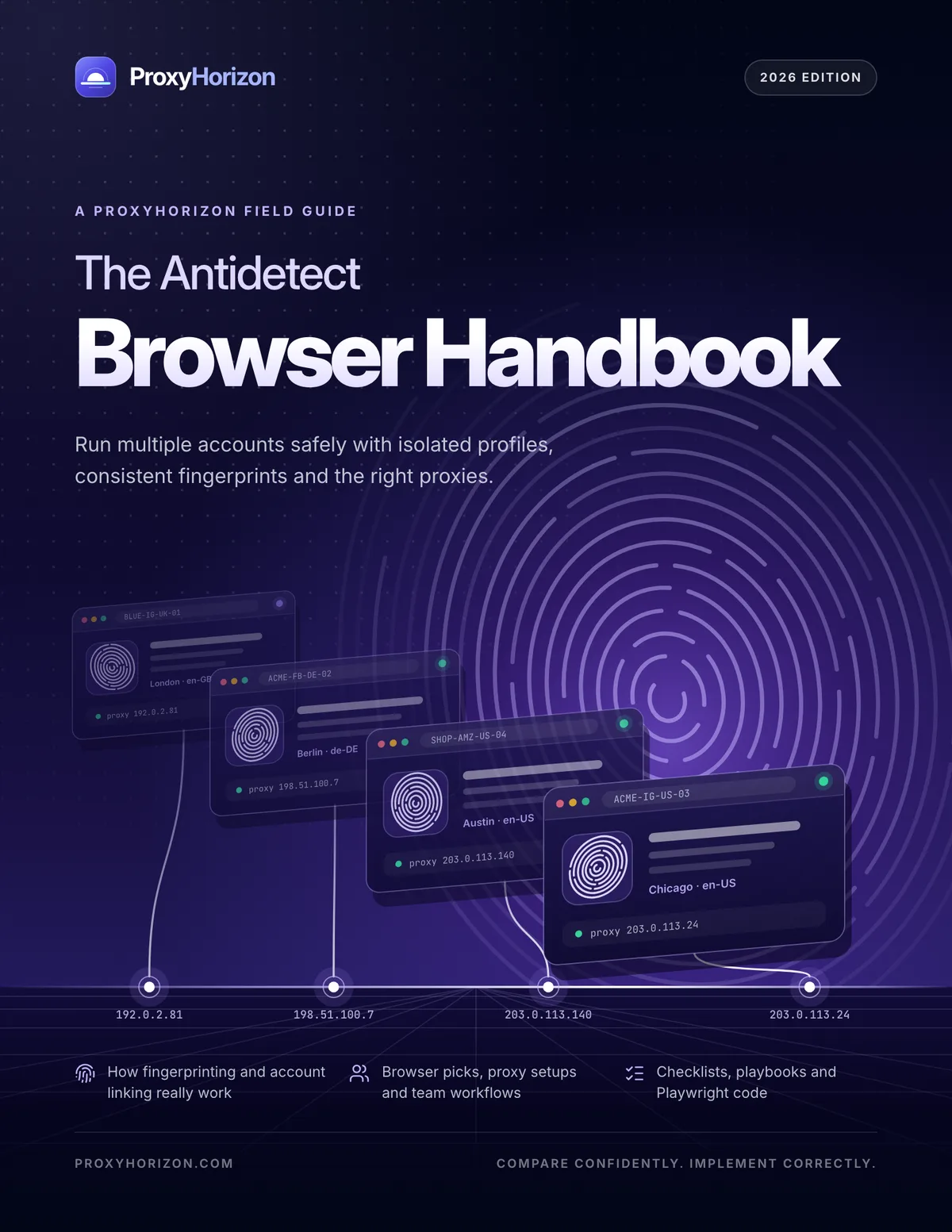
59 pages · Free PDF
The Antidetect Browser Handbook
The free guide to running multiple accounts safely with profiles, fingerprints and proxies.
Read moreGet the eBook, free
59 pages, no sign-up, no email gate. Keep it open next to your pipeline, and run the checklists before every launch.