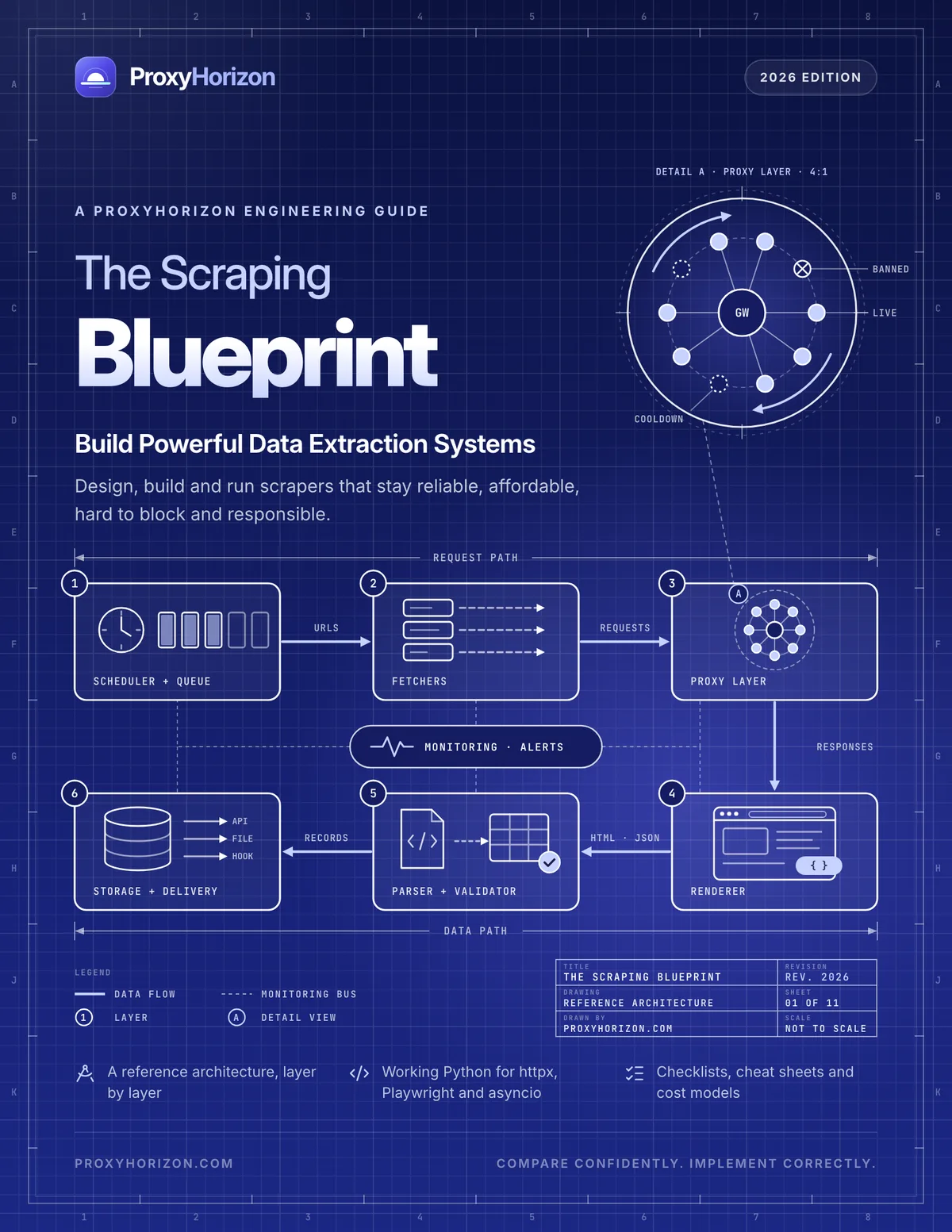
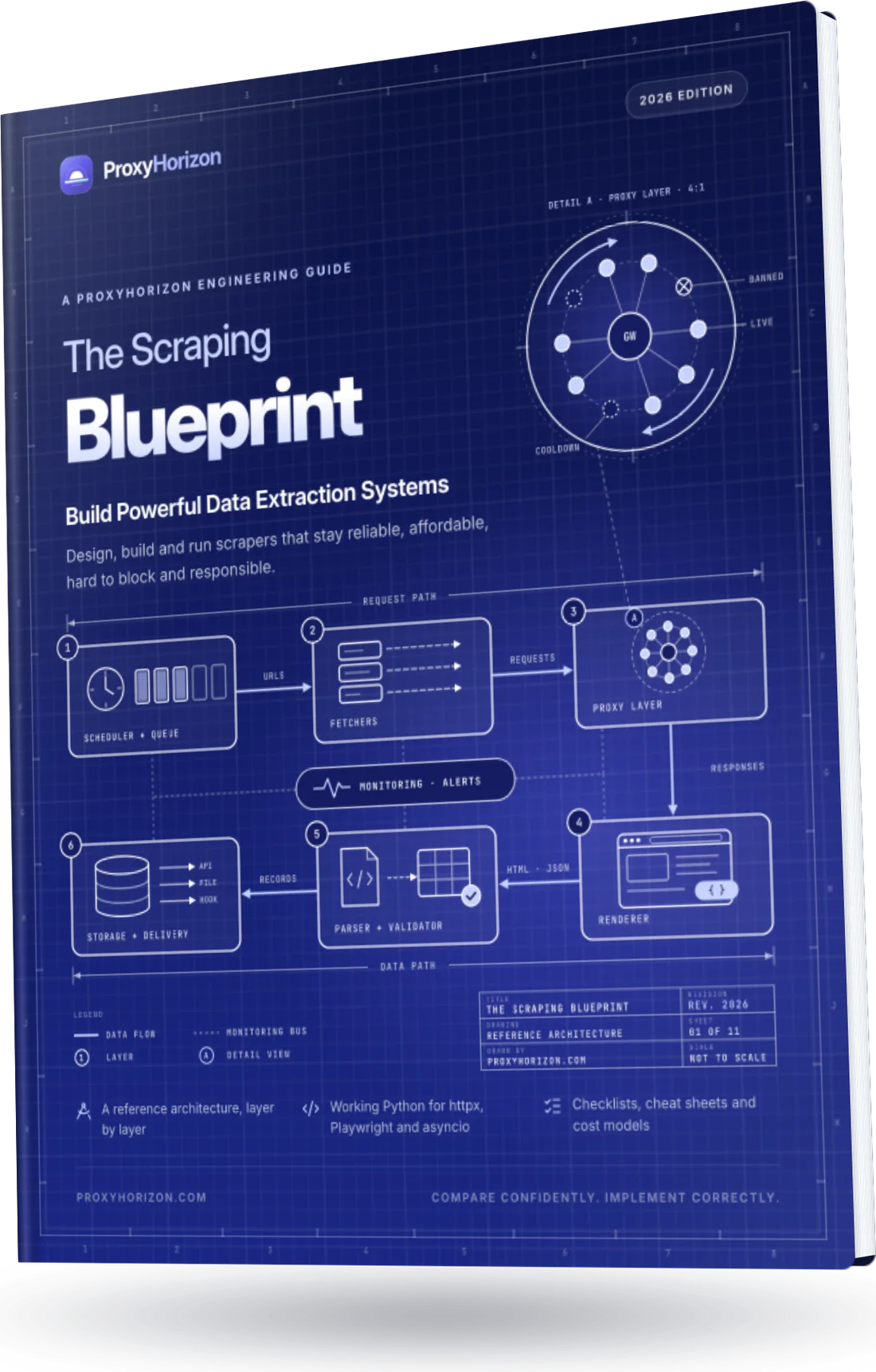
The Scraping Blueprint
The free engineering guide to building scraping systems that stay reliable, affordable and unblocked.
- A reference architecture, explained layer by layer
- Working Python for httpx, Playwright, asyncio, lxml and pydantic
- Checklists, cheat sheets and a full cost model
PDF · 60 pages · 5.4 MB · No sign-up needed
- Pages
- 60
- Chapters
- 11
- Diagrams
- 26
- Tables
- 27
- Code examples
- 13
About the eBook
The blueprint for scrapers that keep working
Most scraping tutorials stop at the happy path: one script, one page, one CSV. The Scraping Blueprint covers everything around that script: the queue, fetchers, proxies, browsers, parsers, storage and monitoring that turn it into a system you can trust with real decisions.
It splits a scraping system into six layers, shows what each one owns and how it fails, and gives you working patterns for all of them, from reading a target before you write code to running the whole thing in production on a budget. A system map on every chapter opener shows exactly where you are.
A scraper is a script. A scraping system is a promise that the data will be right tomorrow.
By the end, you'll be able to
- Read a target and find the cheapest route to its data before writing code
- Build fetchers that retry, back off and stay polite, with a browser only where it pays
- Write extraction that survives redesigns and validates every record
- Crawl millions of pages with a frontier, per-host limits and deduplication
- Route each target to the cheapest proxies that work, and diagnose blocks by symptom
- Run it in production with SLOs, runbooks and a cost per 1,000 good pages
Look inside
Real pages from the blueprint
Architecture drawings, decision paths, working code and checklists you can use the same day. Select any page to see it full size.
What's inside
11 chapters, layer by layer
Start with Chapter 1, then jump to the layer that hurts most. Every chapter ends with key takeaways.
- 01p. 5
The Anatomy of a Scraping System
Six layers plus monitoring, static and dynamic targets, a maturity ladder and the build-or-buy call.
- 02p. 9
Recon: Read the Target Before You Write Code
robots.txt, sitemaps, hidden JSON APIs, pagination, rate ceilings and a page-type inventory.
- 03p. 14
Fetching Pages Reliably
HTTP clients, coherent headers, timeouts, jittered retries and a status-code playbook.
- 04p. 20
Rendering JavaScript Without Burning Money
When a browser pays for itself, and how blocking, response capture and contexts keep it cheap.
- 05p. 24
Parsing and Extraction That Survives Redesigns
A selector hierarchy, typed extraction with pydantic, LLM extraction and fill rate.
- 06p. 29
Crawling at Scale
URL frontiers, canonical URLs, deduplication, per-host politeness and throughput math.
- 07p. 34
The Proxy Layer
Per-target proxy routing, sessions, pool health, cost per 1,000 good pages and nine networks to test.
- 08p. 40
Staying Unblocked
How anti-bot systems score a request, the escalation ladder, and symptom-to-fix diagnosis.
- 09p. 44
Data Quality, Storage and Delivery
Validation layers, drift detection, change tracking, storage choices and data contracts.
- 10p. 48
Running It in Production
Scheduling, SLOs and alerts, a runbook and a full monthly cost model.
- 11p. 52
Scraping Responsibly
Public versus gated and personal data, the law in brief, etiquette and a launch checklist.
- Ap. 56
Appendix
A pre-launch checklist, HTTP status and CSS-to-XPath cheat sheets, a glossary and free tools.
Who it's for
Written for the people who build and run scrapers
Developers and data engineers
Fetching, parsing, crawling and anti-bot patterns with working code, so scrapers break less and recover faster.
Technical founders
A layer-by-layer view of what you would own, and a cost model for deciding between building and buying.
Data and analytics teams
Validation layers, drift alerts, storage choices and data contracts for tables people can trust.
SEO and growth engineers
Recon, scheduling and proxy routing for tracking rankings, prices and competitors on a schedule that holds.
FAQ
Questions, answered
Is The Scraping Blueprint really free?
Yes. There's no sign-up and no email gate: download the PDF and start reading. You're welcome to share it with your team, unchanged and with credit.
Who is it for?
Developers and data engineers who build scrapers, technical founders deciding whether to build or buy web data, data teams who own the tables downstream, and SEO and growth engineers who track sites on a schedule. It assumes you can code in Python.
Do I need to know about proxies first?
No. The book explains what the proxy layer has to do in a scraping system, but it doesn't re-teach proxy basics. If you're new to proxy types, read The Ultimate Proxy Handbook first, which is free too.
What format is it in?
A 60-page PDF of about 5.4 MB, with clickable links and a bookmark for every chapter and section. It reads well on screen and prints cleanly on US Letter or A4.
Does the code work as-is?
The examples use current, well-known libraries (httpx, Playwright, lxml, pydantic and curl_cffi) and placeholder hosts such as shop.example.com. Swap in your own targets, proxy credentials and selectors, and test against a few saved pages before you schedule anything.
Is it vendor-neutral?
Yes. ProxyHorizon is independent. The nine proxy networks are listed alphabetically with figures from the ProxyHorizon directory, and the book contains no affiliate links.
Does it cover the legal side of scraping?
It has a chapter on scraping responsibly: public versus gated and personal data, terms of service, copyright, database rights and privacy law in brief, plus a launch checklist. It isn't legal advice, and it says so.
More free eBooks
All eBooks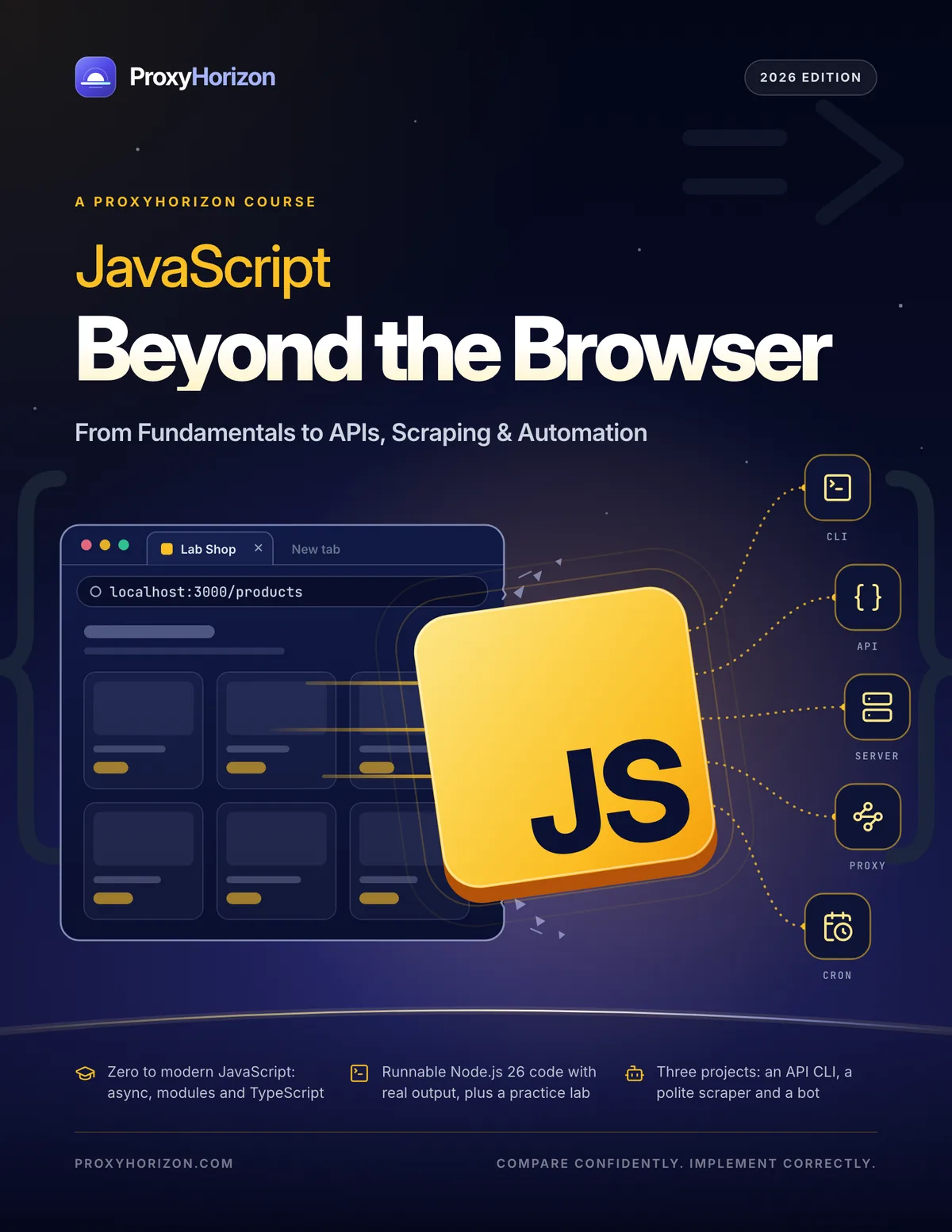
123 pages · Free PDF
JavaScript Beyond the Browser
The free course that takes you from your first line of JavaScript to APIs, scrapers and automation bots.
Read more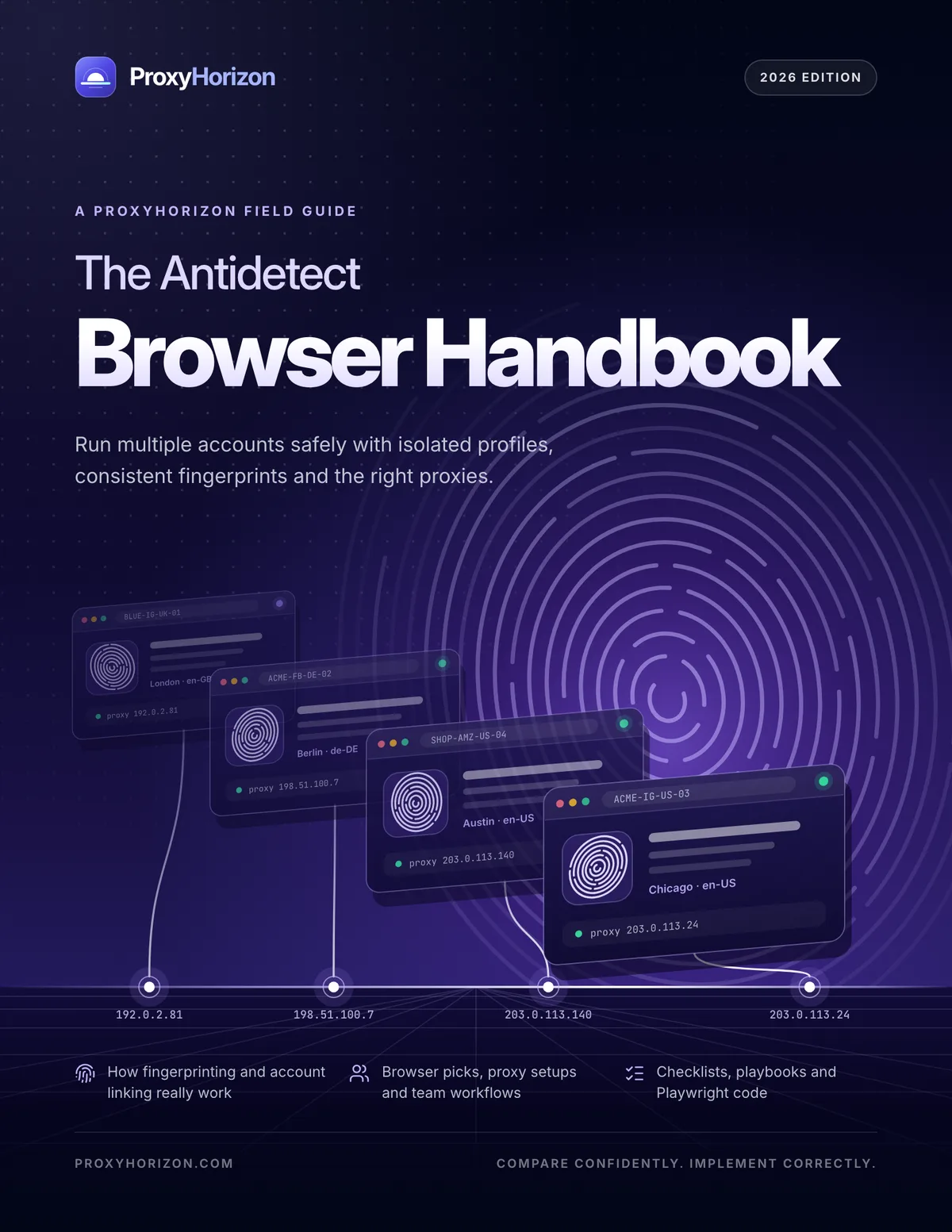
59 pages · Free PDF
The Antidetect Browser Handbook
The free guide to running multiple accounts safely with profiles, fingerprints and proxies.
Read more
59 pages · Free PDF
Proxies for AI Agents and LLM Data
The free guide to collecting, grounding and acting on web data for AI, reliably and responsibly.
Read moreGet The Scraping Blueprint, free
60 pages, no sign-up, no email gate. Keep it next to your code, and come back to the checklists before every launch.