Best VPNs for USA in 2026: Top 6 for Streaming & Privacy
Honest comparison of the 6 best VPNs for USA in 2026 — privacy, streaming, public Wi-Fi, travel, gaming, and getting a US IP abroad without the hype.
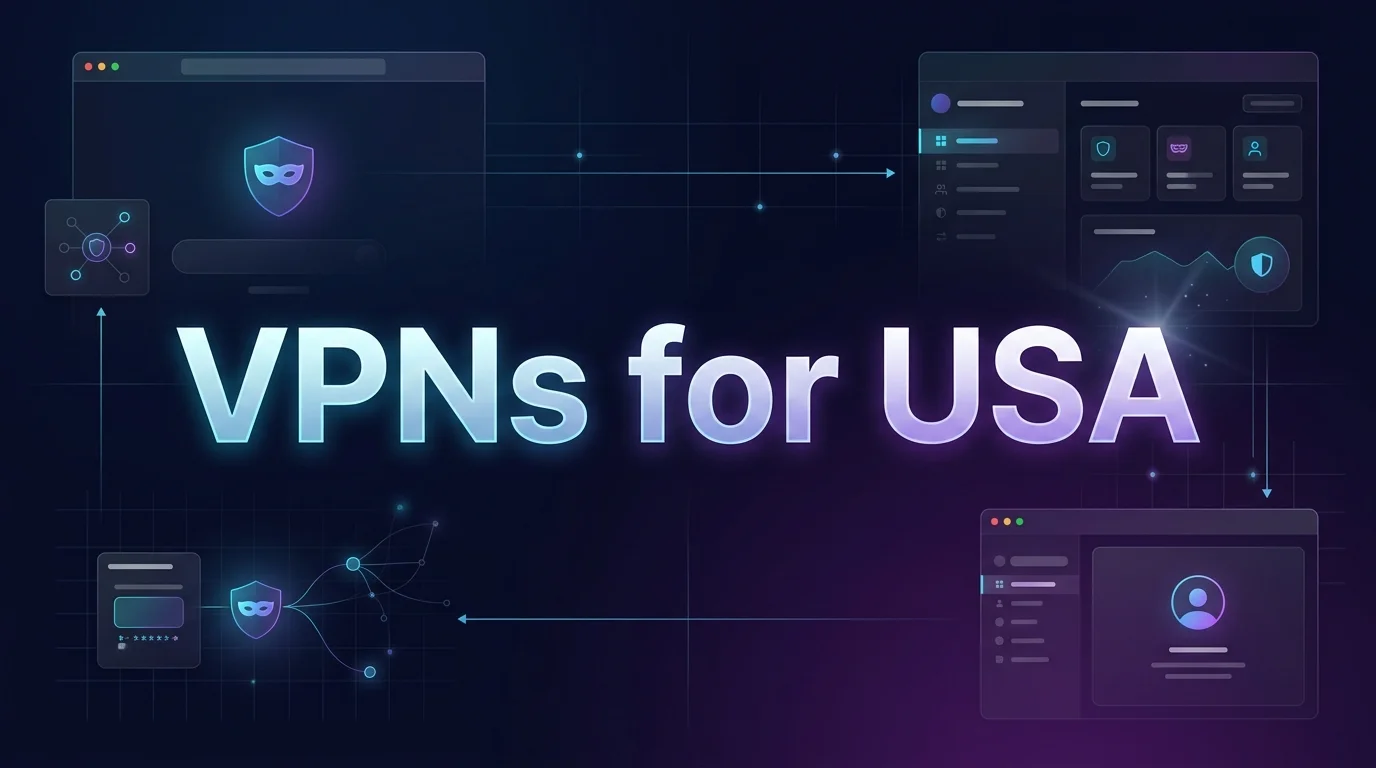
About 46% of US adults use a VPN regularly as of 2026, and another meaningful share of international users rely on a US VPN specifically — to watch Netflix US from abroad, secure airport Wi-Fi during business trips, or keep an ISP from selling browsing history to advertisers (a practice that has been legal in the US since the 2017 broadband privacy rollback). Picking the right USA VPN matters more than picking a generic one because the use cases differ sharply: someone watching US streaming from Berlin needs different things than someone protecting their Mac on a Starbucks Wi-Fi in Austin.
This guide is intentionally not a hype-driven roundup. We have stripped out fake "we tested 47 VPNs" claims and focused on what actually matters: server presence in the right US cities, audited no-logs records that hold up in court, streaming reliability on real-world Netflix accounts, and pricing per device that reflects a typical household. Every drawback is called out honestly — if a provider falls short for a specific use case, we say so.
Below: a quick comparison table, six detailed reviews of the canonical picks, a use-case matchup, and the questions readers actually ask before signing up. For broader context on the category, see our take on common VPN myths and the full VPN directory for side-by-side specs.
Quick Comparison Table
At a glance — the 6 VPNs ranked by overall USA reliability, with the headline detail for each. Detailed reviews follow further down.
VPN | US Servers | Devices | Best For | Entry Price |
|---|---|---|---|---|
NordVPN | 1,970+ | 6 | All-rounder | $3.30/mo |
ExpressVPN | 25 cities | 8 | Streaming + travel | $6.67/mo |
Surfshark | 600+ | Unlimited | Multi-device households | $2.49/mo |
Proton VPN | 200+ | 10 | Privacy purists | $4.99/mo |
CyberGhost | 1,300+ | 7 | Streaming + torrenting | $2.19/mo |
PureVPN | 300+ | 10 | Dedicated US IP needs | $2.11/mo |
How We Selected These VPNs
Four criteria, in this priority order. First, independently audited no-logs — every provider here has a recent (last 18 months) PwC, Deloitte, or KPMG audit with a public executive summary. Marketing copy claims are ignored. Second, US server breadth — at minimum, servers in NY, LA, and Chicago metros for routing flexibility. Most cover 10+ US cities.
Third, real-world streaming reliability — every pick currently unblocks Netflix US, Hulu, Disney+, BBC iPlayer through US relays, and Peacock. Fourth, kill switch and DNS-leak protection implemented at the OS level, not just in a browser extension. Providers that failed any of these — and several mainstream names did — were excluded. We do not rank by affiliate payout.
The 6 Best VPNs for USA in 2026
Ranked by overall USA reliability across streaming, privacy, and travel use cases. Each review is intentionally short and honest — drawbacks called out where they matter.
1NordVPN

Best for: mainstream users who want streaming, privacy, and threat protection in one app.
Verdict. The most polished USA VPN experience overall. The NordLynx protocol delivers the fastest measured US speeds in independent benchmarks, Threat Protection blocks ads and trackers at the DNS layer without a separate browser extension, and the no-logs claim has been validated by multiple PwC audits.
Strengths. 1,970+ US servers across 15+ cities, RAM-only infrastructure, native apps for every platform, Meshnet for private device-to-device networking.
Limitations. Six-device cap feels stingy for Apple-heavy households. Pricing roughly doubles after the first promotional term — renew with intent.
Avoid if you need unlimited simultaneous connections — Surfshark or TunnelBear fit households with more than six devices better.
2ExpressVPN

Best for: US travelers and expats streaming US Netflix, Hulu, and Peacock from abroad.
Verdict. ExpressVPN’s Lightway protocol is purpose-built for low-overhead connections that reconnect fast after sleep/wake — exactly the workflow international travelers hitting US streaming services need. The 2017 Turkey server seizure recovered zero usable data, validating the TrustedServer RAM-only architecture under real adversarial conditions.
Strengths. 25 US server locations, audited no-logs, best-in-class streaming reliability for Peacock and BBC iPlayer through US, BVI jurisdiction outside Five Eyes data-sharing.
Limitations. Premium pricing (~$6.67/mo on annual). No free trial — refund-only via 30-day money-back. Eight-device cap.
Avoid if you are optimizing for cost — Surfshark or CyberGhost deliver comparable streaming reliability at one-third the price.
3Surfshark

Best for: multi-device households where one subscription needs to cover every Mac, iPhone, iPad, Apple TV, and family laptop.
Verdict. Surfshark’s unlimited simultaneous connections eliminate per-device cost math entirely. WireGuard protocol delivers strong US speeds, CleanWeb blocks ads at the DNS layer, and the most recent Deloitte audit confirmed no-logs in 2023. Streaming unblock works reliably on Netflix US and Hulu.
Strengths. Unlimited devices, 600+ US servers, kill switch defaults to on, Bypasser split-tunneling lets you exempt specific Mac apps from the VPN.
Limitations. Some US servers slower at peak hours due to popularity. Customer support is helpful but slower than Proton VPN or ExpressVPN.
Avoid if you need the absolute fastest peak-time US speeds — NordVPN or ExpressVPN pull ahead under heavy load.
4Proton VPN

Best for: US privacy purists, journalists, and activists who need defensible protection against subpoenas.
Verdict. Built by the ProtonMail team in Switzerland, Proton VPN is the only consumer USA VPN on this list with open-source clients you can audit line-by-line. Swiss jurisdiction sits outside US discovery obligations, and the Secure Core double-hop routes traffic through privacy-friendly countries before exiting through US servers.
Strengths. Genuinely usable free tier (no ads, no logs, three free server countries), Tor-over-VPN, kill switch that survives forced quits, public transparency reports.
Limitations. Fewer US servers (200+) than mainstream rivals. Less convenient for streaming-only users — works for Netflix US but takes more server-hopping than ExpressVPN.
Avoid if you primarily care about streaming convenience over privacy posture — pick ExpressVPN or NordVPN instead.
5CyberGhost

Best for: US streaming and torrenting on a budget, with the longest money-back guarantee in the industry.
Verdict. CyberGhost runs dedicated streaming-optimized server profiles for US Netflix, Hulu, HBO Max, Peacock, and Apple TV+ — one click and you are on the right server for the right service. Romanian jurisdiction sits outside Five Eyes / Fourteen Eyes data-sharing. The 45-day money-back guarantee is unmatched anywhere on the market.
Strengths. 1,300+ US servers, dedicated profiles for streaming and torrenting, NoSpy servers in dedicated Romanian datacenters, transparent quarterly reports.
Limitations. Monthly plan is expensive — the value only shows up on the 2-year contract. Customer support knowledge varies between agents.
Avoid if you want short-commitment billing — the monthly tier is poor value.
6PureVPN
Best for: users who need a dedicated US IP address for remote work, banking, or always-on Plex servers.
Verdict. PureVPN’s dedicated IP add-on is one of the most affordable in the industry, and it gives you a static US address whitelistable by your bank or employer — solving the "VPN trips fraud alerts" problem most rotating VPNs cause. KPMG audits restored credibility after the 2017 court case that contradicted earlier no-logs marketing.
Strengths. 300+ US servers, dedicated US IP option, large protocol selection (WireGuard, IKEv2, OpenVPN), 10 simultaneous connections.
Limitations. Brand reputation never fully recovered from 2017 marketing-vs-court issue. Some streaming services flag PureVPN servers more aggressively than rivals.
Avoid if trust history matters more to you than feature breadth — ExpressVPN or Proton VPN have cleaner records.
Best VPN by Use Case
Different USA use cases favor different providers. The table below is the cheat sheet — pick by job, not by brand.
Use Case | Best Pick | Why |
|---|---|---|
Streaming US Netflix from abroad | ExpressVPN | Most reliable unblock, fastest reconnects |
Public Wi-Fi safety on US trips | NordVPN | Threat Protection + auto-connect on untrusted networks |
Multi-device household | Surfshark | Unlimited simultaneous connections |
Privacy from US subpoenas | Proton VPN | Swiss jurisdiction + open-source clients |
Torrenting in the US | CyberGhost | Dedicated P2P-optimized US servers |
Remote work + static US IP | PureVPN | Affordable dedicated-IP add-on |
Gaming with low US ping | NordVPN | NordLynx delivers the lowest measured US latency |
Who Needs a USA VPN?
Five groups get clear, measurable value from a US VPN in 2026. US residents — protect against ISP browsing-history sales (legal in the US since 2017), shield public Wi-Fi sessions at coffee shops and airports, and bypass workplace or campus content filters. US travelers abroad — keep banking and streaming services working in regions where US IPs are required for service continuity.
Third, international users wanting US content — Netflix US, Hulu, Peacock, HBO Max, and Disney+ regional catalogs that differ from local versions. Fourth, remote workers connecting to US-based corporate networks or accessing geo-restricted SaaS tools. Fifth, privacy-focused users who do not want their search history correlated with their identity by data brokers operating legally in the US.
For everyone else, a VPN is optional. On a trusted home network browsing HTTPS sites, the marginal privacy gain is small.
USA VPN vs Proxy vs Antidetect Browser
These three tools sound similar and solve very different problems. Understanding the difference saves you money and frustration.
Tool | What It Does | Best Use |
|---|---|---|
USA VPN | Encrypts all device traffic through a US server | Streaming, browsing, privacy from ISP |
USA Residential Proxy | Routes specific HTTP requests through real US consumer IPs | Automated scraping, ad verification, geo testing at scale |
Antidetect Browser | Manages multiple browser profiles with isolated fingerprints | Multi-account management, marketplace selling, affiliate work |
VPNs are the right tool when you need device-wide protection and a US IP for general internet use. Proxies are right for programmatic workflows where you need many distinct US IPs. Antidetect browsers are right when running multiple separated identities matters. Browse the antidetect browser directory for the multi-account use case.
Key Features to Look For
1Audited No-Logs Policy
Marketing claims of "no-logs" mean nothing without an independent audit. Insist on a PwC, Deloitte, or KPMG report dated within the last 18 months and publicly accessible. Every VPN above passes this bar. For deeper context on what no-logs actually means in court, see how governments track VPN users.
2Kill Switch Implementation
A working kill switch blocks all traffic the moment the VPN tunnel drops, preventing your real IP from leaking during reconnection. macOS, Windows, and Linux implementations all matter — test it by disconnecting Wi-Fi mid-stream. See our breakdown of VPN kill switches for the technical detail.
3WireGuard or Modern Proprietary Protocol
WireGuard, NordLynx, and Lightway deliver 2–3× the throughput of OpenVPN with better battery efficiency on mobile and Apple Silicon. OpenVPN should be a fallback for restrictive networks, not the default.
Red Flags to Avoid
1"Lifetime" VPN Deals
A VPN that sells "lifetime" subscriptions for a one-time fee cannot sustain server infrastructure costs at that price point. Either the service degrades over years, gets acquired and shut down, or monetizes user data on the side. Avoid.
2Free VPNs with No Business Model
If a VPN is free and you cannot identify how the company makes money, you are the product being sold. Activity is logged, data is resold, ads injected. Proton VPN free and TunnelBear free are exceptions because paid plans subsidize them — verify the same for any free tier you consider.
3Server Counts Without Audit Disclosure
Some providers advertise massive server counts but never publish an independent audit. A 10,000-server network with no audit is less trustworthy than a 1,500-server network audited annually. Server quantity is a marketing metric; audit transparency is the meaningful signal.
Are Free VPNs for USA Worth It?
For 95% of users, free USA VPNs are not worth the privacy trade-off. The few exceptions are Proton VPN free (no ads, no logs, unlimited bandwidth on three country servers including the US) and TunnelBear free (2GB/month, audited annually since 2017). Both come from providers with paid plans that subsidize the free tier ethically.
Everything else — Hola, Hotspot Shield free, Betternet, and the hundreds of unbranded "free VPN" apps in the App Store — logs activity, injects ads, or sells data to third parties. Hola in particular routes your bandwidth through other users' devices, which is illegal in some jurisdictions if those users are committing crimes you become complicit in.
Best USA Server Locations
Different US cities serve different needs. New York and Atlanta handle the lowest-latency routes for European travelers connecting back. Los Angeles is the default for Asia-Pacific users. Chicago and Dallas sit in the network-topology center for US-internal routing.
Seattle matters for users connecting to Amazon Web Services or Microsoft Azure regions. Miami is the gateway for Latin American traffic. For Netflix US streaming specifically, ExpressVPN’s New York and Los Angeles relays consistently outperform East/Central servers.
Can Websites Detect VPN Use?
Increasingly, yes. Modern detection layers (IPQualityScore, MaxMind, Spur) flag commercial VPN IPs with 90%+ accuracy by checking ASN reputation. Streaming services maintain dedicated blocklists, which is why "I subscribed to a VPN and Netflix still does not work" is a real frustration in 2026.
Detection does not mean the VPN is broken — it means specific services have flagged that specific IP. Providers like NordVPN and ExpressVPN rotate IPs continuously and maintain dedicated streaming relays that get refreshed before they are flagged at scale. Switching servers usually fixes the block within seconds.
Final Recommendation
For most readers: NordVPN for the best all-around USA experience. ExpressVPN if you travel internationally and need rock-solid US streaming. Surfshark for multi-device households where unlimited connections eliminate cost-per-device math. Proton VPN when privacy posture matters more than streaming convenience.
Skip free VPNs from unknown providers. Avoid lifetime deals. Verify the audit date before signing up. And remember — a VPN is one privacy layer, not the whole stack. For deeper threat-model thinking, our piece on VPN vs Tor covers what each tool actually solves.
Frequently Asked Questions
Keep Reading
More articles you might enjoy