How to Rotate Proxies in Playwright (2026 Guide)
A short, practical guide to rotating proxies in Playwright — three working methods with copy-paste Python, from per-context swaps to a hands-off rotating gateway.

If you scrape with Playwright and keep hitting blocks, CAPTCHAs, or rate limits, the fix is almost always the same: stop sending every request from one IP. Rotating proxies spread your traffic across many addresses so no single one gets flagged — and Playwright makes this refreshingly easy once you know where the proxy option lives.
This is a short, practical guide. You will get three working ways to rotate proxies in Playwright — from a simple per-context swap to a fully managed gateway — with copy-paste Python you can adapt in minutes. Let us get into it.
Why Rotate Proxies in Playwright?
Websites track how many requests come from each IP. Send too many too fast and you get throttled or blocked. Rotating proxies make each request (or each session) look like a different user, which is why proxies are essential for web scraping at scale.
Our take: use residential proxies for strict targets and datacenter for lenient, high-volume ones. Whatever the type, the rotation technique in Playwright is the same.
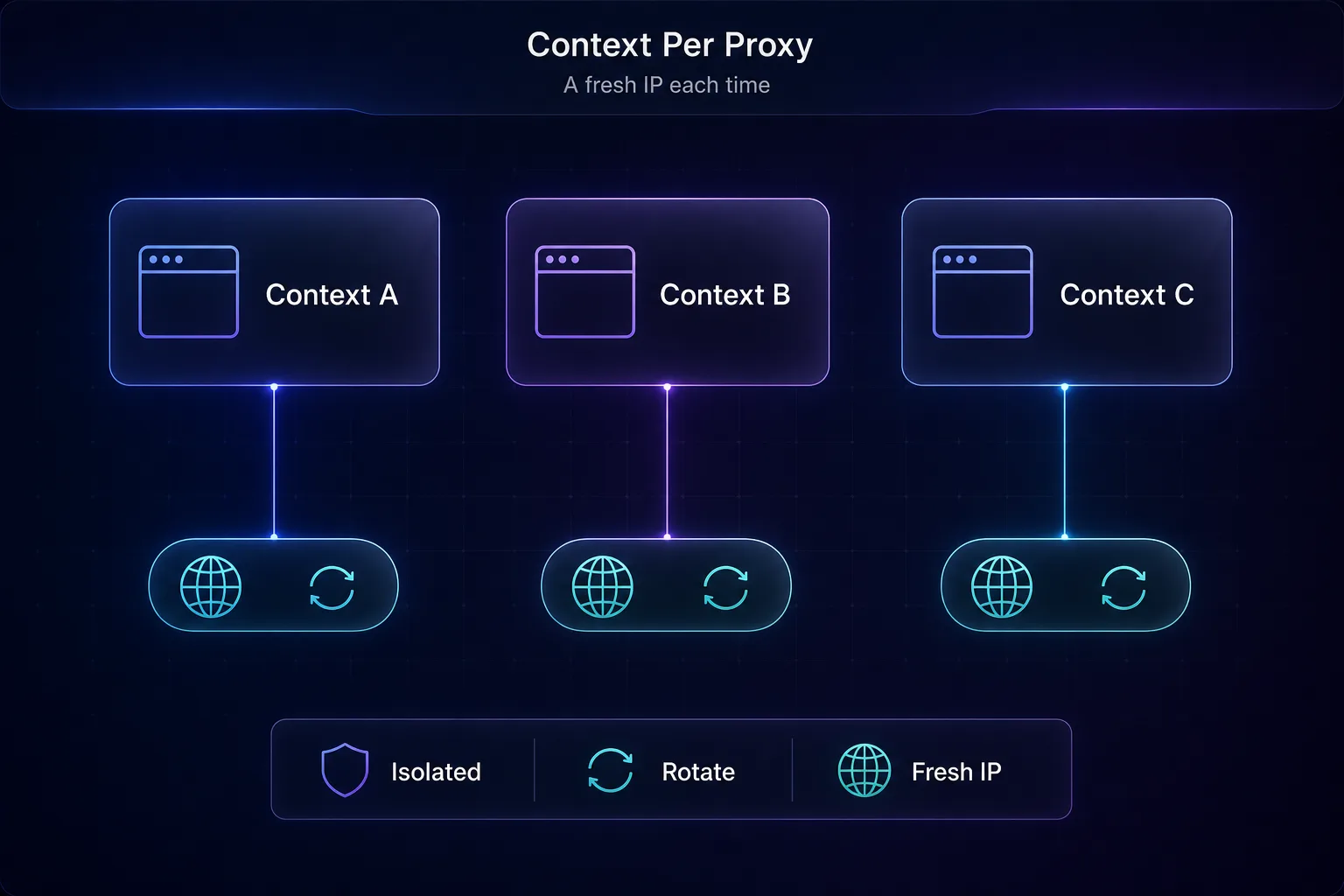
Method 1: A New Context Per Proxy
The cleanest way to rotate in Playwright is one browser context per proxy. Each context is an isolated session with its own cookies, cache, and proxy — so swapping the proxy per context gives you a fresh identity every time.
from playwright.sync_api import sync_playwright

proxies = [
    {"server": "http://p1.provider.com:8000", "username": "user", "password": "pass"},
    {"server": "http://p2.provider.com:8000", "username": "user", "password": "pass"},
    {"server": "http://p3.provider.com:8000", "username": "user", "password": "pass"},
]

with sync_playwright() as p:
    browser = p.chromium.launch(headless=True)
    for proxy in proxies:
        context = browser.new_context(proxy=proxy)
        page = context.new_page()
        page.goto("https://httpbin.org/ip")
        print(page.inner_text("body"))
        context.close()
    browser.close()
Each loop opens a new context on a different proxy, checks the visible IP, then closes it. Closing the context frees resources and guarantees the next request starts clean.
Method 2: Rotate Through a Proxy List
For real scraping you want to pull from a list and cycle through it. A simple helper keeps things tidy and lets you rotate on every request or every N requests.
import itertools
from playwright.sync_api import sync_playwright

proxy_pool = itertools.cycle(proxies)  # cycles forever

urls = ["https://example.com/1", "https://example.com/2", "https://example.com/3"]

with sync_playwright() as p:
    browser = p.chromium.launch(headless=True)
    for url in urls:
        proxy = next(proxy_pool)          # grab the next proxy
        context = browser.new_context(proxy=proxy)
        page = context.new_page()
        page.goto(url, timeout=30000)
        # ... scrape the page here ...
        context.close()
    browser.close()
Using itertools.cycle means the pool never runs out — it loops back to the start. Add a small random delay between requests to look more human and reduce the chance of a block.
Method 3: Use a Rotating Proxy Gateway (Easiest)
The simplest option is to let your provider handle rotation. Most residential providers give you a single gateway endpoint that assigns a fresh IP from their pool on every request — no list to manage at all.
from playwright.sync_api import sync_playwright

# One endpoint; the provider rotates the IP for you
gateway = {
    "server": "http://gate.provider.com:7000",
    "username": "user",
    "password": "pass",
}

with sync_playwright() as p:
    browser = p.chromium.launch(headless=True)
    context = browser.new_context(proxy=gateway)
    page = context.new_page()
    for i in range(5):
        page.goto("https://httpbin.org/ip")
        print(page.inner_text("body"))   # a different IP each time
    context.close()
    browser.close()
This is the least code and the most scalable, because the provider maintains the pool, health-checks IPs, and handles rotation logic for you. For most people, this is the right choice.
| Method | Effort | Best For |
|---|---|---|
| Context per proxy | Low | Small, fixed proxy lists |
| Proxy-list cycle | Medium | Custom rotation logic |
| Rotating gateway | Lowest | Scale, hands-off rotation |
Best Proxies to Rotate in Playwright
Rotation is only as good as the IPs behind it. These three providers offer clean pools and simple rotating endpoints that drop straight into the code above.
1Decodo

Best all-rounder. Decodo (formerly Smartproxy) gives you a rotating gateway and sticky sessions with an easy dashboard — ideal for Method 3 above. Great geo-coverage and beginner-friendly pricing make it the safest starting point.
2Oxylabs

Best for scale. Oxylabs pairs a huge IP pool with an advanced rotation engine and strong docs — built for large Playwright scraping jobs that need reliability at volume. Premium-priced, but rock-solid.
3IPRoyal

Best value. IPRoyal's non-expiring traffic and friendly pricing make it a great place to test rotation without a big commitment. Compare all options in our proxy directory.
Tips for Reliable Rotation
- Add random delays. A short, randomized pause between requests looks far more human than rapid-fire calls.
- Handle failures. Wrap
page.gotoin try/except and retry on a fresh proxy when one times out. - Use sticky sessions for logins. Rotating mid-session breaks logged-in flows — hold one IP for those, and see how proxy rotation works under the hood.
- Match the proxy type to the target. Residential for strict sites, datacenter for lenient, high-volume ones.
- Rotate more than the IP. Vary user agents and headers too — the IP is one signal among many.
Frequently Asked Questions
Conclusion
Rotating proxies in Playwright comes down to one idea: give each request or session a different IP. Use a new context per proxy for small lists, cycle through a pool for custom control, or lean on a rotating gateway for hands-off scale — the last option is the right default for most projects.
Pair the technique with a quality proxy pool, add delays and retries, and rotate more than just the IP, and your Playwright scrapers will run far longer before hitting a wall. Ready to set it up? Browse proxies built for rotation in our proxy directory, or compare two providers with our comparison tool.
Keep Reading
More articles you might enjoy