The Best Residential Proxy Providers of 2026
The best residential proxy providers of 2026, compared by pool size, coverage, and price, with honest picks for scraping, geo-targeting, and account management.
![The Best Residential Proxy Providers of [year]](/_next/image?url=https%3A%2F%2Fproxyhorizon.com%2Fcdn%2Fblog-images%2Fbest-residential-proxies-1-ms8q3uv1.webp&w=3840&q=75)
Residential proxies are the reason a scraper can pull prices from a strict retail site, a marketer can verify ads in ten countries, and a researcher can gather public data without getting blocked by request 40. They route your traffic through real home IP addresses, so target sites treat you like an ordinary visitor instead of a bot. That single trait is why they cost more than datacenter IPs, and why picking the right provider actually matters.
The market is noisy. Every provider claims the biggest pool, the cleanest IPs, and the best price, and a lot of "best residential proxy providers" lists are affiliate roundups written by people who never fired a real request. We took the opposite approach: this guide leads with what separates a genuinely good residential network from a marketing page, then names the residential proxies worth your money in 2026 and, just as importantly, who each one is actually for.
By the end you'll know which provider fits your use case, how to avoid overpaying for a pool you don't need, and the buying mistakes that quietly wreck success rates. If you want the fundamentals first, our guide on what a residential proxy is covers the basics; this is the buyer's guide.
What Makes Residential Proxies Worth the Premium
A residential proxy borrows an IP address from a real device on a real internet service provider, then sends your request through it. To the target site, the traffic looks like it came from a home in Chicago or Berlin, not a cloud server in a data center. That's the whole trick, and it's a big one, because most anti-bot systems weigh IP reputation heavily.
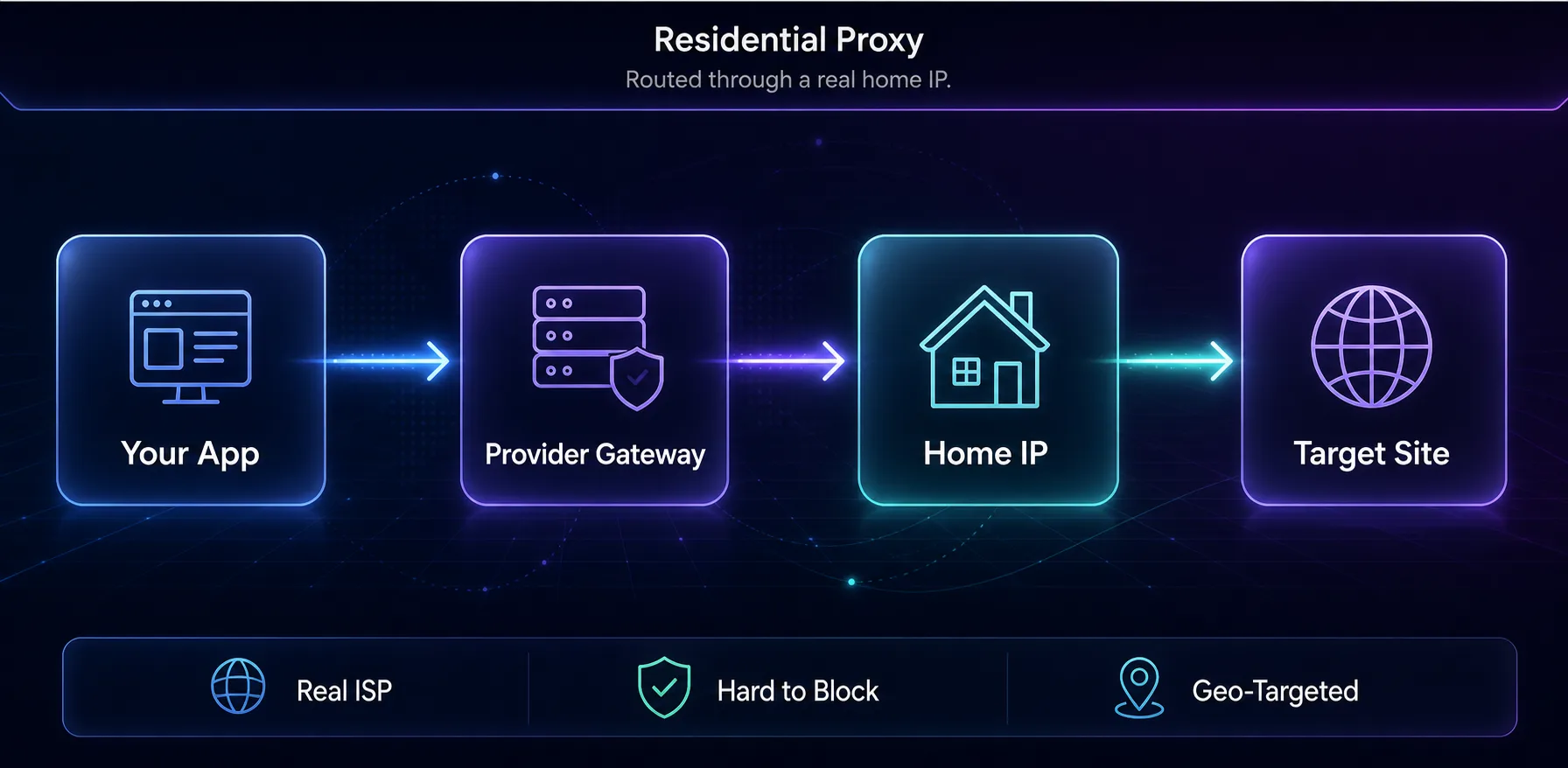
A residential proxy routes your request through a real home IP, so sites see an ordinary visitor.
The catch is that this quality is expensive to source and maintain, so you pay per gigabyte instead of per IP, and prices vary wildly. The proof is in the block rate: on strict targets, a clean residential IP might sail through where a datacenter proxy gets flagged on the first request. In plain English, you're paying for trust, not speed. When trust is what stands between you and the data, residential wins.
Residential vs Datacenter vs Mobile: Which Type Fits
Residential isn't automatically the right answer. It's the stealthy, mid-speed, mid-to-high-cost option, and for plenty of jobs a cheaper or faster type does the work. Match the tool to the target, not to the hype.
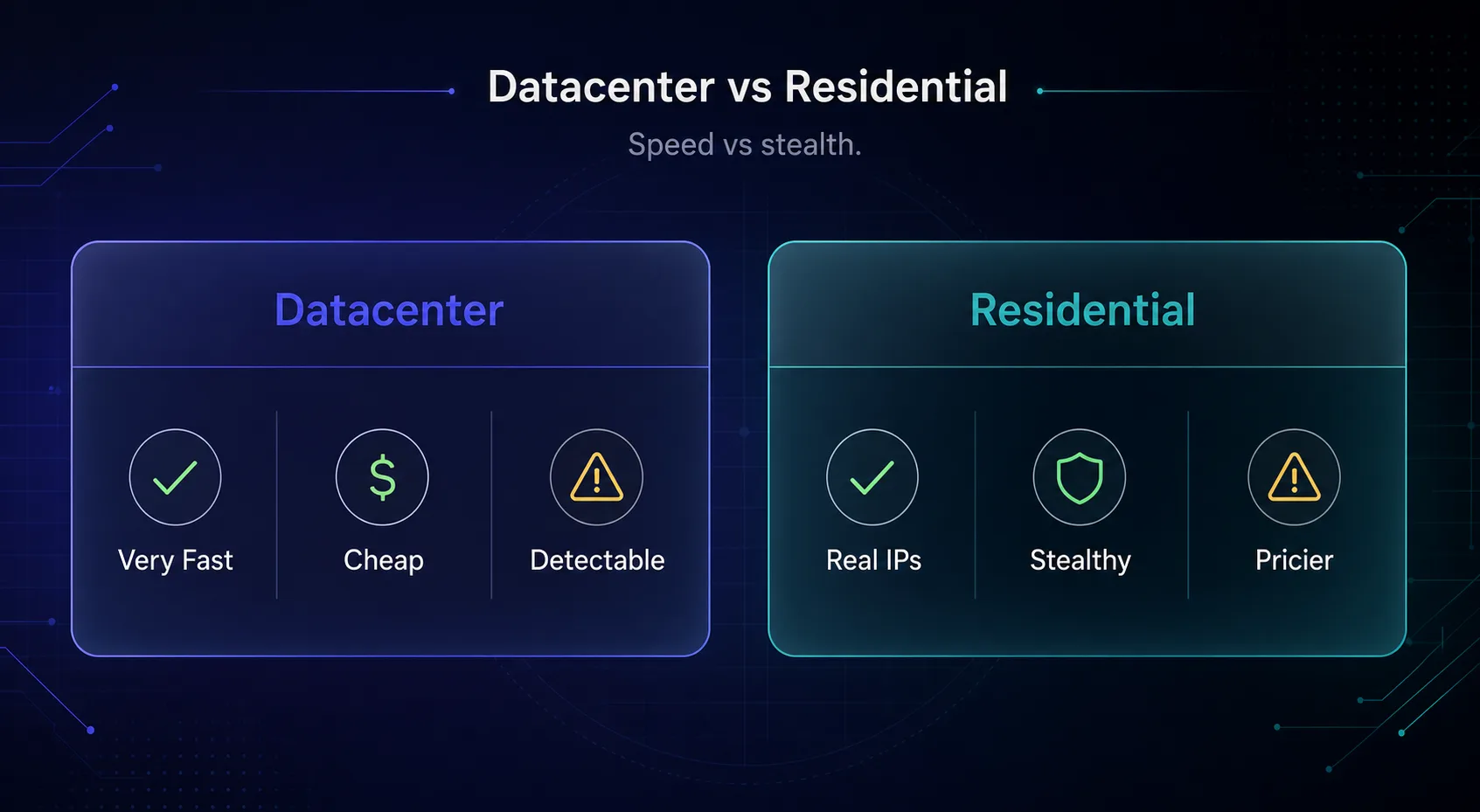
Datacenter is fast and cheap but easy to flag; residential trades speed for stealth.
Proxy type | How sites see it | Speed | Cost | Best for |
|---|---|---|---|---|
Residential | Real home ISP IP | Medium | $$ | Strict sites, geo-targeting, stealth scraping |
Datacenter | Cloud/server IP | Very fast | $ | Lenient sites, SEO checks, bulk tasks |
Mobile (4G/5G) | Carrier IP, shared by many | Medium | $$$ | Social media, the hardest targets |
ISP (static residential) | Hosted but ISP-registered | Fast | $$$ | Long logged-in sessions, account stability |
If your targets are lenient, save money with datacenter IPs. If you're managing social accounts, look at mobile proxies. For everything in between, where you need to look like a real user at reasonable cost, residential is the sweet spot. Most of the providers below sell more than one type, so you can mix as needed.
How We Picked These Providers
We weighted the things that actually decide success on the job: pool size and IP quality, country and city-level coverage, rotation and sticky-session control, average success rate on tough targets, transparency about sourcing, and honest pricing. We also leaned on hands-on familiarity with these dashboards and public documentation rather than marketing claims. A quick disclosure: some links below are affiliate links, and we may earn a commission if you sign up. It never changes who makes this list or the order.
The Best Residential Proxy Providers in 2026
Seven providers earn a spot, each strong for a different reason. Read the first line of each entry for the one-word verdict on who it's for.
1Oxylabs

Oxylabs is the pick for serious scale and enterprise reliability. Its residential network spans 100M+ IPs across 195 countries with near-perfect uptime, and its tooling, including an AI-driven unblocker for the nastiest anti-bot targets, is among the most advanced anywhere. Support and compliance are genuinely enterprise-grade, which matters when you're running data collection as a business function.
The trade-off is price and complexity. This is premium infrastructure priced accordingly, and it's overkill for a hobby project or a small store. If you need volume, stability, and a vendor that won't blink at millions of requests, though, Oxylabs is hard to beat.
2Decodo

Decodo, formerly Smartproxy, is the best all-round value for most users. It pairs a huge 115M+ IP pool and 195-country coverage with the friendliest dashboard in this list and documentation that beginners can actually follow. Setup is quick, entry pricing is reasonable, and success rates on mainstream targets are excellent, which makes it the one we recommend to people buying their first residential plan.
It isn't always the rock-bottom price per gigabyte at very low volume, and the rebrand from Smartproxy still confuses some searchers. Neither is a real knock. For the balance of ease, quality, and cost, Decodo is the default choice.
3BrightData

BrightData is the most powerful data-collection platform of the bunch, best for teams that need granular control and strict compliance. Beyond a large residential network, you get city, ASN, and carrier targeting, a mature web-data suite, and a compliance process (KYC on sensitive use cases) that big organizations require. If you can dream up a targeting rule, BrightData probably supports it.
All that power comes with a learning curve and pricing that takes study to optimize. Beginners often feel lost in the console. But for advanced, high-stakes projects where control and legitimacy are non-negotiable, it's a top-tier option.
4SOAX

SOAX stands out for clean, precisely targetable IPs from an enormous pool. It's the pick when geo-precision matters: country, region, and city targeting are reliable, and its IP-vetting keeps the pool clean, which shows up as strong success rates. The flexible plans suit researchers and marketers who need specific locations rather than raw volume.
Costs can climb as you scale, and a few of the nicer controls live on higher tiers. For work that lives or dies on hitting the right location with trustworthy IPs, SOAX earns its place near the top.
5IPRoyal

IPRoyal is the best fit for pay-as-you-go buyers who hate the "use it or lose it" model. Its headline feature is non-expiring residential traffic: buy the data, use it whenever, no monthly pressure. Add a low entry price and a straightforward dashboard, and it's ideal for smaller projects, freelancers, and anyone with unpredictable, bursty usage.
The pool is smaller than the giants above, and the platform is less feature-rich for advanced targeting. For flexible, budget-conscious residential access without a subscription clock ticking, though, it's excellent value.
6NodeMaven

NodeMaven is built for stability, making it the pick for account management and long sessions. Its filter-first approach screens IPs for quality before they reach you, and it advertises the longest sticky sessions on the market, so a single identity can stay put for hours instead of rotating mid-task. That's exactly what you want for logged-in workflows and multi-accounting.
It's a newer, smaller network than the established names, so raw pool size is more modest. If your priority is clean IPs that hold a session rather than sheer scale, NodeMaven is a smart specialist choice.
7Webshare

Webshare is the friendliest on-ramp for budget buyers and testers. It's known for affordable, self-serve plans and a genuine free trial, so you can validate residential proxies against your own target before spending real money. The dashboard is simple, and for light residential use it's one of the cheapest ways in.
The residential pool is smaller and covers fewer countries than the leaders, and Webshare is stronger on datacenter proxies overall. For a first test or a low-volume project on a tight budget, it's a sensible starting point. You can line it up against the others in our proxy provider directory.
Residential Proxy Providers Compared
Here's the shortlist side by side. Pool size and coverage tell you about reach; uptime and response time hint at day-to-day reliability. Treat the "best for" column as the fast way to your shortlist.
Provider | Residential pool | Countries | Uptime | Avg response | Best for |
|---|---|---|---|---|---|
Oxylabs | 102M+ | 195 | 99.99% | 0.6s | Enterprise scale |
Decodo | 115M+ | 195 | 99.99% | 0.6s | Best all-round value |
BrightData | 72M+ | 195 | 99.99% | 0.5s | Compliance + tooling |
SOAX | 191M+ | 195 | 99.95% | 0.6s | Precise geo-targeting |
IPRoyal | 32M+ | 195 | 99.9% | 0.8s | Pay-as-you-go |
NodeMaven | 30M+ | 195 | 99.9% | 0.8s | Sticky sessions |
Webshare | 10M+ | 50 | 99.97% | 1.0s | Budget entry |
How to Choose a Residential Proxy Provider
The "best" provider is the one that fits your job. Answer these four questions before you pay for anything.
1What Are You Actually Doing?
Scraping strict e-commerce sites, verifying ads, and managing social accounts all stress a network differently. High-volume scraping rewards a big, well-rotated pool; account work rewards clean IPs and long sticky sessions. Name the task first, then match the provider to it rather than chasing the biggest pool number.
2How Much Traffic Will You Use?
Residential is billed by the gigabyte, so your monthly data volume drives cost more than anything else. Light or unpredictable usage suits pay-as-you-go models like IPRoyal; steady high volume makes the per-GB rate at Oxylabs or Decodo the number to negotiate. Estimate honestly, because overbuying is the most common waste.
3Do You Need Specific Locations?
If your work depends on appearing in a particular country, region, or city, check the provider's real coverage there, not just its global IP count. A 200M-IP pool is useless if only a handful sit in the city you need. SOAX and BrightData shine when precise geo-targeting is the requirement.
4Can You Test Before Committing?
Never sign an annual deal on faith. Use a trial or a small plan to run your actual target through the network and measure success rate and speed. Our guide on how to test proxy speed and anonymity walks through a quick, fair benchmark you can run in an afternoon.
Common Mistakes When Buying Residential Proxies
Most bad proxy experiences trace back to a handful of buying errors, not bad luck. Sidestep these and your success rate climbs before you touch your code.
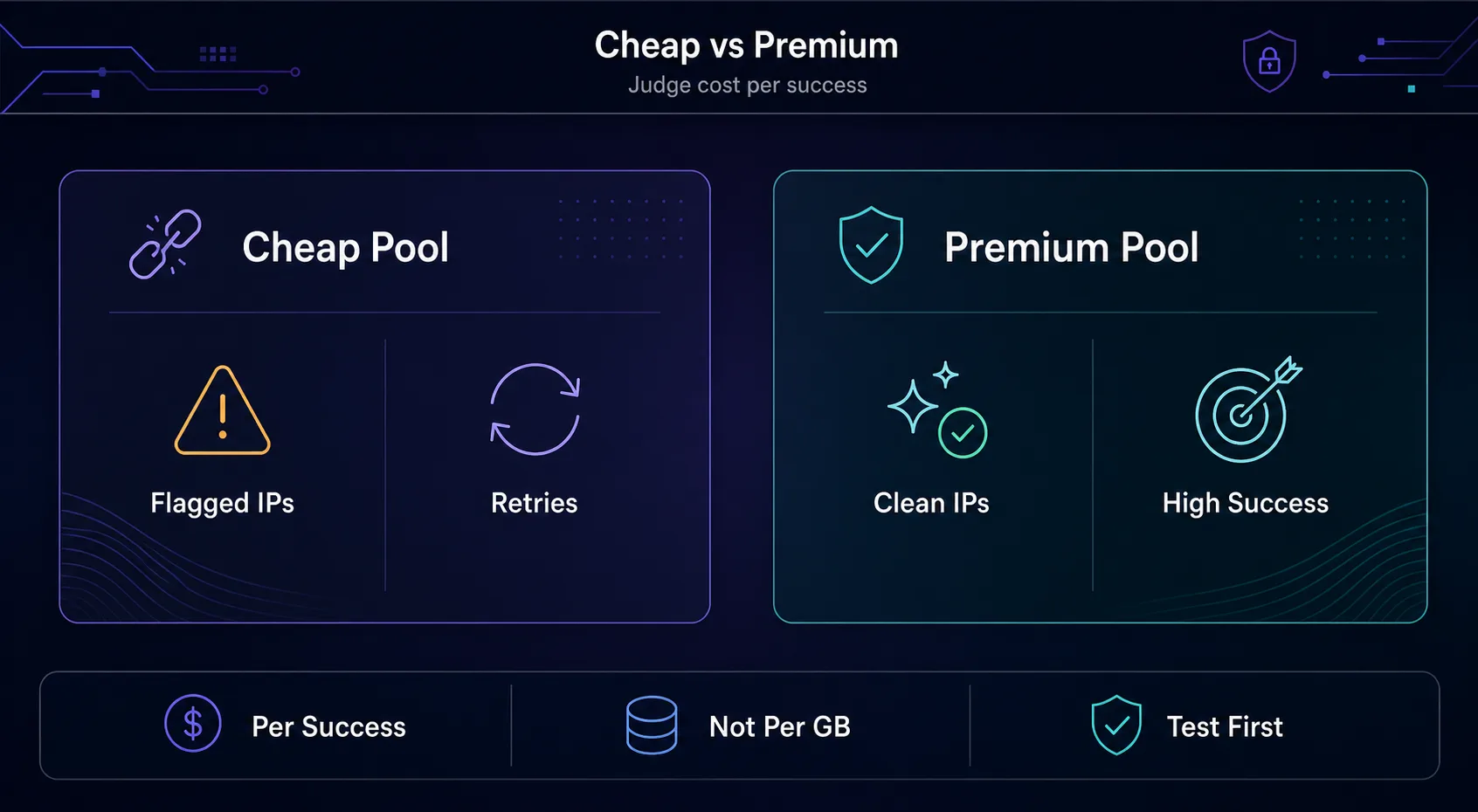
Cheap pools look like a bargain until flagged IPs and retries erase the savings.
1Chasing the Lowest Price Per GB
The cheapest pool is cheap for a reason: recycled, flagged, or overused IPs that fail often. Every failed request is a retry, and retries burn the bandwidth you thought you were saving. Judge providers on cost per successful request, not the sticker rate per gigabyte.
2Buying a Bigger Pool Than You Need
A 200M-IP network sounds impressive, but if your job needs 500 clean IPs in Germany, raw pool size is vanity. Coverage and quality in your target locations beat a giant global number every time. Pay for relevance, not bragging rights.
3Ignoring Rotation and Session Control
Rotating a fresh IP on every request will break any logged-in workflow, while a sticky IP that never changes will get a scraper banned. Understand how each provider handles rotation and sticky sessions and pick settings that match the task, not the default.
4Skipping the Sourcing Question
Cheap "residential" IPs are sometimes sourced from users who never knowingly consented, which is both an ethical problem and a reliability one. Reputable providers are transparent about how they build their pool. If a network can't explain where its IPs come from, treat that as a red flag.
5Not Testing on Your Real Target
A provider that crushes a generic benchmark can still stumble on your specific site. Always validate against the exact target you care about before scaling, because success rates vary enormously by destination.
Tips to Get the Most From Residential Proxies
Once you've chosen well, these habits protect your success rate and your budget.
Start on a small plan and benchmark your real target before committing to volume.
Match rotation to the job: sticky sessions for logins, per-request rotation for wide scraping.
Target the narrowest geo you need, not the whole world, to keep IP quality high.
Pair proxies with good behavior: realistic headers, sane request rates, and human-like timing.
Monitor success and cost per request, not just gigabytes used, so you catch a degrading pool early.
Residential proxies are a force multiplier, but they aren't a magic cloak. If your headers and request pattern look robotic, even the cleanest IP won't save you. Treat the proxy as one layer of a good setup, and read our scraping-focused residential picks if data collection is your main use case.
Frequently Asked Questions
The Bottom Line
Residential proxies buy you trust, and the right provider turns that trust into a high success rate without wrecking your budget. The pool size on the marketing page matters far less than clean IPs, coverage where you need them, and settings that match your task. Choose for the job, test before you scale, and judge everything on cost per successful request.
If you want a quick steer: Decodo is the best all-round value for most people, Oxylabs is the enterprise workhorse, BrightData wins on compliance and control, and IPRoyal is the flexible pay-as-you-go pick. Grab a trial, run your real target through it, and compare the shortlist head to head in our proxy provider directory before you commit.
![OpenClaw vs Hermes Agent: Which Is Better? ([year])](/_next/image?url=https%3A%2F%2Fproxyhorizon.com%2Fcdn%2Fblog-images%2Fopenclaw-vs-hermes-agent-1-mu16j93j.webp&w=3840&q=75)
![Grok Bot vs OpenClaw vs Hermes vs n8n ([year])](/_next/image?url=https%3A%2F%2Fproxyhorizon.com%2Fcdn%2Fblog-images%2Fgrok-bot-vs-openclaw-vs-hermes-vs-n8n-1-mtzmbk5w.webp&w=3840&q=75)
![Grok Bot vs Claude Cowork vs ChatGPT Work ([year])](/_next/image?url=https%3A%2F%2Fproxyhorizon.com%2Fcdn%2Fblog-images%2Fgrok-bot-vs-claude-cowork-vs-chatgpt-work-1-mtzmbgoq.webp&w=3840&q=75)