How Do Proxies Help With SEO Monitoring? (2026)
How proxies help with SEO monitoring: see neutral, location-accurate rankings, track local SERPs and competitors, and scale rank checks without getting blocked.
![How Do Proxies Help With SEO Monitoring? ([year])](/_next/image?url=https%3A%2F%2Fproxyhorizon.com%2Fcdn%2Fblog-images%2Fproxies-for-seo-monitoring-1-msgiwiv6.webp&w=3840&q=75)
Try this: search your main keyword from your office, then ask a colleague across the country to search the same thing. You'll often see different rankings. Now imagine checking 500 keywords across 20 cities, every day. Do it from one IP and Google blocks you within minutes. That gap, between the rankings you think you have and the ones real users actually see, is exactly the problem proxies solve for SEO teams.
Search results aren't universal. Google personalizes them by location, history, and device, and it aggressively rate-limits anyone querying at scale. So the honest answer to how proxies help with SEO monitoring is this: they let you see neutral, location-accurate rankings and gather them at volume without getting blocked. Without proxies, serious rank tracking simply doesn't work past a handful of manual checks.
This guide covers why SEO monitoring breaks without proxies, what they actually let you track, the right proxy type for the job, and how proxy-based rank tracking works under the hood. If you're ready to shop, our roundup of the best SEO proxies for SERP scraping ranks specific providers; this is the why and how.
Why SEO Monitoring Needs Proxies at All
Two hard realities make proxies non-negotiable for real SEO work. The first is personalization. Google tailors results to your location, search history, and device, so the rankings you see from your desk are your rankings, not the neutral truth. To measure where a page really sits, you need a clean, un-personalized query from the right location.
The second is rate limiting. Google processes billions of searches a day (Google) and guards against automated querying hard. Fire a few dozen rank checks from one IP and you'll hit CAPTCHAs, then blocks. Proxies spread those queries across many IPs so each one looks like a normal, occasional searcher. This is the same reason web scraping needs proxies in general, just applied to search.
What Proxies Let You Monitor
Proxies don't just prevent blocks; they unlock entire categories of SEO data you can't reliably get otherwise. Here's what a proxy-backed setup actually enables.
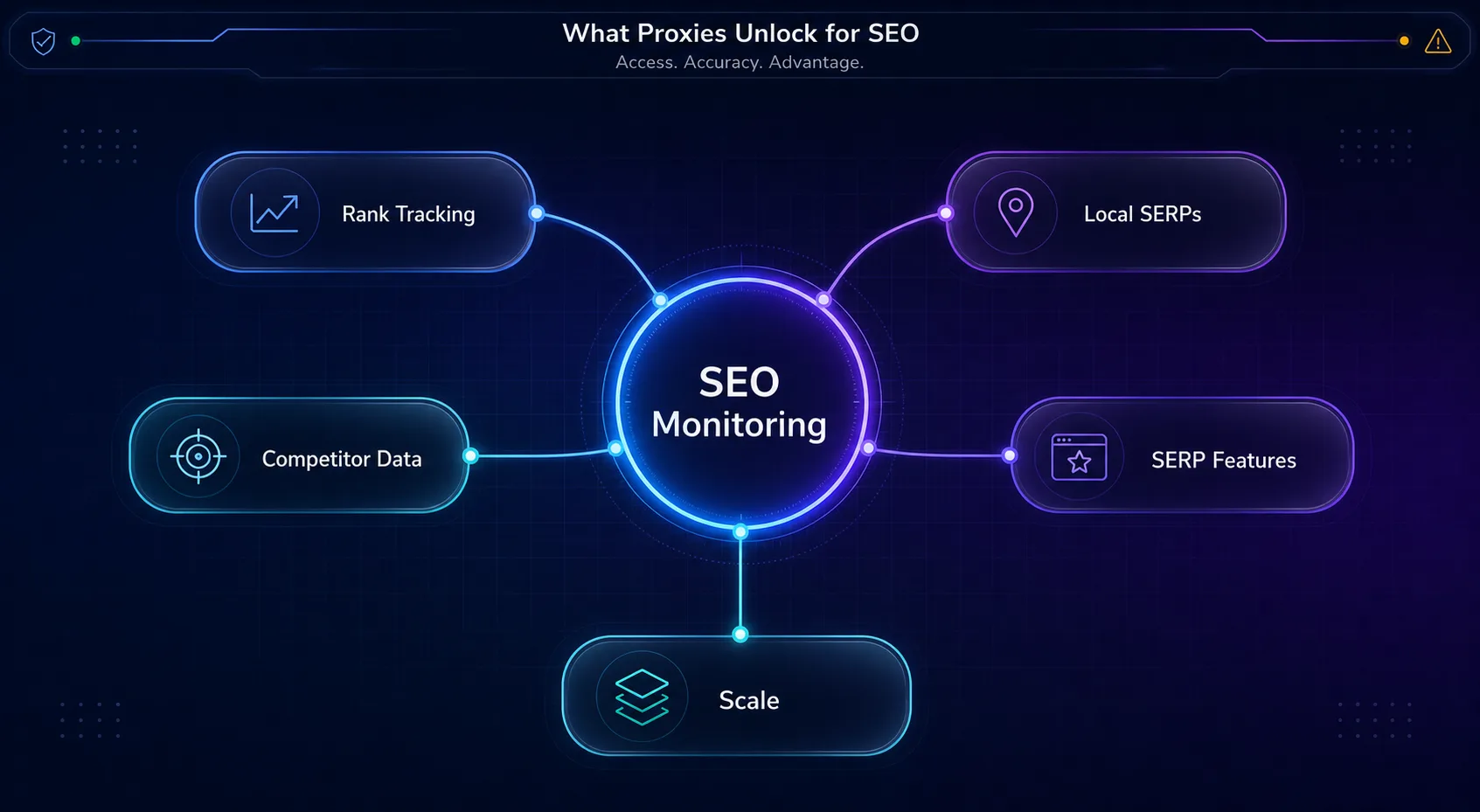
| What you monitor | How proxies make it possible |
|---|---|
| Keyword rankings | Query SERPs repeatedly without your IP getting blocked |
| Local and geo rankings | See real results from any city or country, not just yours |
| Competitor performance | Track many rivals' rankings and content at scale |
| SERP features | Capture snippets, People Also Ask, and local packs as a neutral user sees them |
| Bulk scheduled checks | Spread thousands of daily queries across many IPs safely |
1Keyword Rank Tracking
The core use case. Proxies let a rank tracker query the same keywords day after day from consistent locations without tripping Google's defenses, so your position data stays complete instead of full of gaps where checks got blocked.
2Local and Geo-Specific SERPs
If you serve customers in specific cities, national rankings are almost meaningless. Proxies with precise geo-targeting let you check how you rank in Chicago versus Miami versus London, which is the only way to measure local SEO honestly.
3Competitor Monitoring
Tracking one competitor by hand is doable; tracking twenty across hundreds of keywords is not. Proxies let you scale competitive research, watching rivals' rankings, new content, and SERP movements, the same way you would for broader market research.
4SERP Feature Tracking
Featured snippets, People Also Ask boxes, image packs, and local results shift constantly and vary by user. A neutral proxy query captures what the average searcher actually sees, so you can chase the snippet you're missing or spot when you've lost one.
Local SEO: Seeing Rankings From Anywhere
This is where proxies go from convenient to essential. Google's results are deeply localized, so a plumber in Denver and a searcher in Boston see completely different local packs for "emergency plumber." You cannot check a Denver ranking from a Boston IP and get an accurate answer, full stop.
Residential and mobile proxies with city-level targeting solve this by placing your query in the exact location you're measuring. Set the proxy to Denver, and Google serves you the Denver SERP. For agencies managing clients across regions, this is the difference between reporting real local performance and guessing. It's the single most underrated reason SEO teams adopt proxies.
Clean Results vs Personalized Results
Even setting location aside, your own search history skews what you see. Google remembers the sites you click and nudges them up for you, so your personal SERP flatters your own pages. That's comforting and useless for measurement.
A fresh proxy IP with no history attached returns a neutral result, closer to what a first-time visitor sees. That neutrality is the whole point of monitoring: you want the objective ranking, not the one Google personalized for you. Pair clean IPs with good IP reputation and you get data you can actually trust to make decisions on.
The Right Proxy Type for SEO Work
Not every proxy suits rank tracking. The best choice balances how much Google trusts the IP against how fast and cheap you can run at volume.
| Proxy type | Fit for SEO monitoring | Notes |
|---|---|---|
| Residential | Best for accurate, un-flagged SERPs | Looks like a real searcher; ideal for local results |
| ISP (static residential) | Excellent balance | Datacenter speed with ISP-level trust and stable IPs |
| Mobile | Best for mobile SERPs and toughest checks | Highest trust, but the priciest option |
| Datacenter | OK for high-volume, lenient checks | Fast and cheap, but Google flags these fastest |
For most SEO monitoring, residential proxies are the sweet spot because they return the most accurate, least-blocked results. ISP proxies are a strong upgrade when you need speed at scale without sacrificing trust. Reserve datacenter for cheap, high-volume checks on targets that don't fight back.
How Proxy-Based Rank Tracking Works
Under the hood, a proxy-backed rank tracker follows a simple, repeatable loop. Understanding it helps you configure any tool or script correctly.
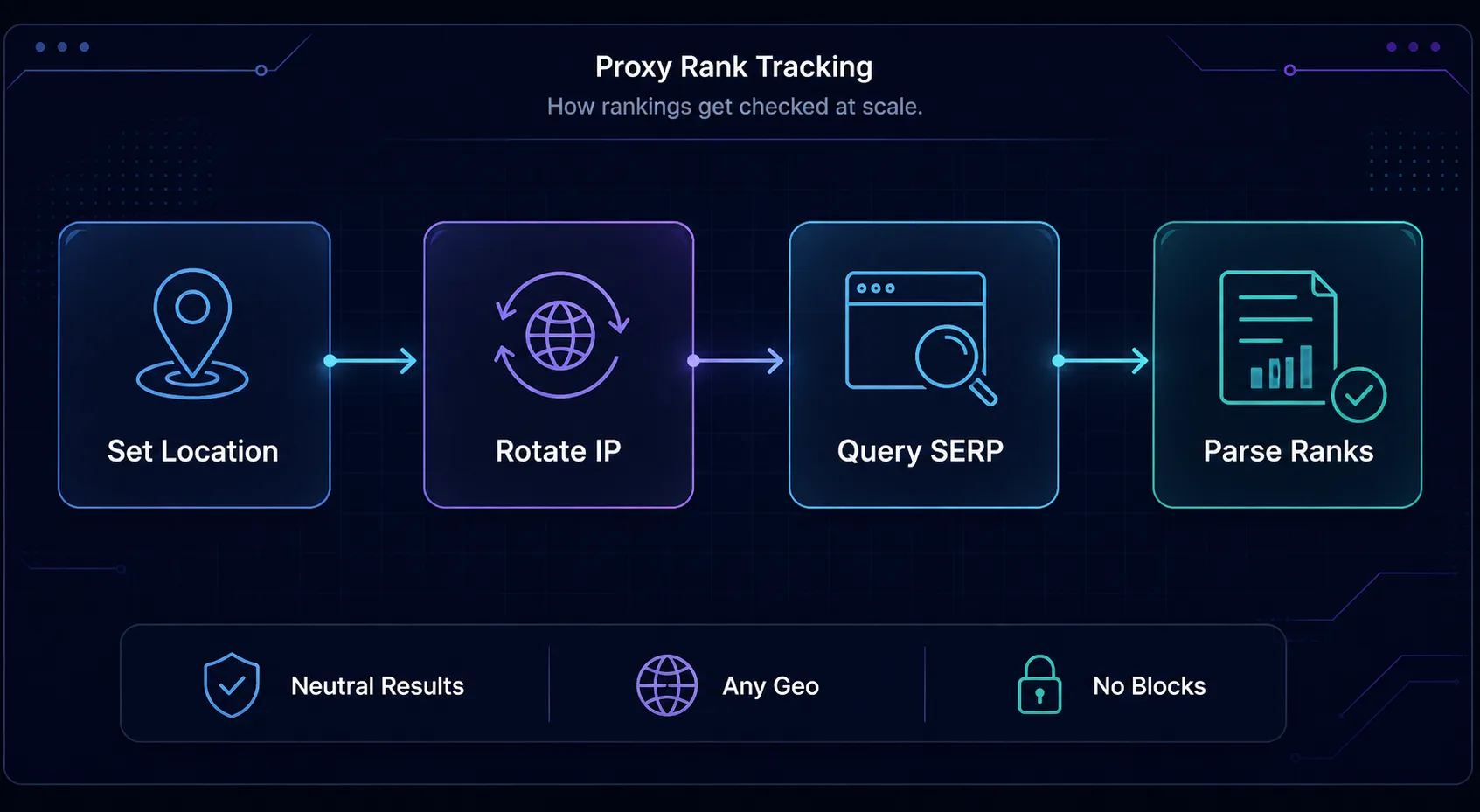
First you set the location so the query targets the right city or country. Then you rotate the IP, using a fresh address for each batch so no single one draws attention. The tool queries the SERP for your keyword, and finally it parses the rankings from the returned page. Good setups add rotation and pacing so the whole thing looks like many separate searchers rather than one relentless bot. Get that rhythm right and you can track thousands of keywords daily without a wall of CAPTCHAs. For a Google-specific deep dive, see our guide on scraping Google search. Google's own Search Central documents how ranking works, which is useful context for what you're measuring.
Best Proxies for SEO Monitoring
SEO monitoring rewards clean IPs, precise geo-targeting, and reliability at scale. How we picked: we favored providers with strong search-scraping support, accurate location targeting, and clean pools that return neutral, un-flagged results. A quick disclosure: some links below are affiliate links, and we may earn a commission if you sign up, which never changes our picks.
1Oxylabs

Oxylabs is the enterprise choice for serious rank tracking. Beyond a huge residential network with precise geo-targeting, it offers dedicated search-scraping infrastructure built to pull SERPs reliably at scale. For agencies and in-house teams monitoring thousands of keywords across regions, that purpose-built tooling saves real engineering effort.
It's premium priced, so it's more than a small site needs. But when accuracy and volume both matter, its consistency is worth paying for.
2BrightData

BrightData is the most powerful and flexible platform for SEO data collection. Granular city, ASN, and device targeting let you replicate almost any searcher's context, and its search-focused tools handle the parsing headaches for you. If your monitoring needs are complex or highly localized, few match its control.
That power comes with a learning curve and pricing that takes study to optimize. For advanced teams that need every targeting lever, though, it's a top-tier option.
3Decodo

Decodo is the best-value pick for most SEO teams. A large residential pool, wide geo-coverage, and a genuinely easy dashboard make it simple to set up location-accurate rank tracking without enterprise complexity or pricing. Success rates on search targets are strong, and getting started is quick.
It isn't the absolute cheapest per gigabyte at tiny volumes, but the balance of accuracy, ease, and cost makes it the one we'd hand most teams first. Compare all three in our proxy provider directory.
Beyond Rank Tracking: More Ways SEO Teams Use Proxies
Rank tracking is the headline use, but proxies quietly power much of the rest of an SEO program. Once you can query the web from any location without blocks, several other jobs open up.
SERP volatility monitoring means checking key terms frequently to catch algorithm updates and ranking swings early, which needs steady, un-blocked access. Content gap analysis uses proxies to pull competitors' top-ranking pages at scale, so you can see what they cover that you don't. Backlink and citation checks verify that your links and local business citations actually appear as intended across regions, not just from your own office IP.
Proxies also support brand and reputation monitoring in search: tracking what shows up when people search your brand from different countries, including autocomplete suggestions and the reviews or news that surface alongside you. And for international SEO, they let you audit hreflang and localized pages the way a real user in each target country would, catching wrong-language-served bugs that are completely invisible from a single location.
The pattern to notice is that proxies aren't an SEO tactic in themselves; they're the access layer that makes data-driven SEO possible. Any task that depends on seeing the web the way your users see it, from anywhere, at the volume the work demands, sits on top of a clean, well-managed proxy pool. Build that foundation once, and every downstream workflow, from a daily rank report to a full international audit, gets faster and more trustworthy.
Common Mistakes in Proxy-Based SEO Monitoring
A few avoidable errors quietly corrupt SEO data or get your checks blocked. Steer around these.
1Using Datacenter IPs for Local Results
Datacenter proxies are cheap, but Google flags them fast and they rarely nail local results. For accurate, city-level rankings, use residential or ISP IPs. Saving money here just buys you inaccurate data.
2Not Setting the Right Location
Checking a keyword without pinning the location gives you a blurred, semi-personalized result. If you care about local or national rankings, always set the proxy's geo to the exact market you're measuring, or your numbers are fiction.
3Querying Too Fast From Too Few IPs
Blasting hundreds of queries through a handful of proxies looks exactly like a bot and triggers blocks. Spread requests across enough IPs and pace them with realistic delays so each looks like a separate, occasional searcher.
4Ignoring Mobile vs Desktop
Rankings differ between mobile and desktop, and many teams only track one. If your audience is mobile-heavy, monitor mobile SERPs too, ideally with mobile proxies, or you're optimizing for the wrong result set.
5Forgetting to Neutralize Personalization
Reusing the same logged-in-feeling setup or sticky IPs with history baked in skews results toward your own pages. Use fresh, clean IPs so you measure the neutral ranking, not the flattering one Google personalized for you.
Frequently Asked Questions
The Bottom Line
Proxies are what make SEO monitoring accurate and scalable. They strip out personalization so you see neutral rankings, place your queries in the exact locations you serve, and spread checks across many IPs so Google never blocks you mid-report. Without them, you're stuck with a handful of skewed, self-flattering results; with them, you get the objective picture your decisions actually need.
Start with clean residential or ISP IPs, set your locations deliberately, and pace your checks. Oxylabs leads for enterprise-scale search scraping, BrightData offers the deepest targeting control, and Decodo is the best value for most teams. Pick the type that matches your accuracy and volume needs, and compare the options in our proxy provider directory before you build your monitoring stack.
![The Best Use Cases of Apify in [year]](/_next/image?url=https%3A%2F%2Fproxyhorizon.com%2Fcdn%2Fblog-images%2Fapify-use-cases-1-mu7brxcq.webp&w=3840&q=75)
![Firecrawl vs Playwright ([year]): Which One to Pick?](/_next/image?url=https%3A%2F%2Fproxyhorizon.com%2Fcdn%2Fblog-images%2Ffirecrawl-vs-playwright-1-mu7brugq.webp&w=3840&q=75)
![IPRoyal vs Thordata ([year]): A Detailed Comparison](/_next/image?url=https%3A%2F%2Fproxyhorizon.com%2Fcdn%2Fblog-images%2Fiproyal-vs-thordata-1-mu5cuh95.webp&w=3840&q=75)