Stateless vs Stateful Scraping Architecture (2026)
Stateless vs stateful scraping architecture explained: what state really is, when each model fits, how sticky and rotating proxies map to each, and how to build a hybrid.
Every scraping project eventually hits the same architectural fork: should each request stand completely on its own, or should your scraper remember what happened before? That single decision shapes how you scale, how you handle failures, how much infrastructure you need, and how easily you get detected.
Most teams never make the choice deliberately. They start stateless because it is the default for a simple HTTP client, then bolt on cookie handling when a login appears, and end up with a fragile hybrid that nobody designed. The result is a scraper that works until it suddenly does not, usually at 3am.
This guide explains stateless vs stateful scraping architecture properly: what state actually consists of, when each model is right, how proxies tie into session affinity, how failure and scaling differ, and how to build a hybrid that gets the best of both. Let us break it down.
- Stateless scraping treats every request as independent, which makes it trivially parallel, cheap to retry, and easy to scale horizontally.
- Stateful scraping preserves cookies, tokens, and IP affinity across a sequence, which is mandatory for logins, carts, and multi-step flows.
- The proxy layer must match: stateless pairs with rotating IPs, stateful requires sticky sessions so the IP does not change mid-journey.
- Most mature scrapers are hybrid: stateless by default, with small stateful islands only where a session is genuinely required.
What Stateless Scraping Means
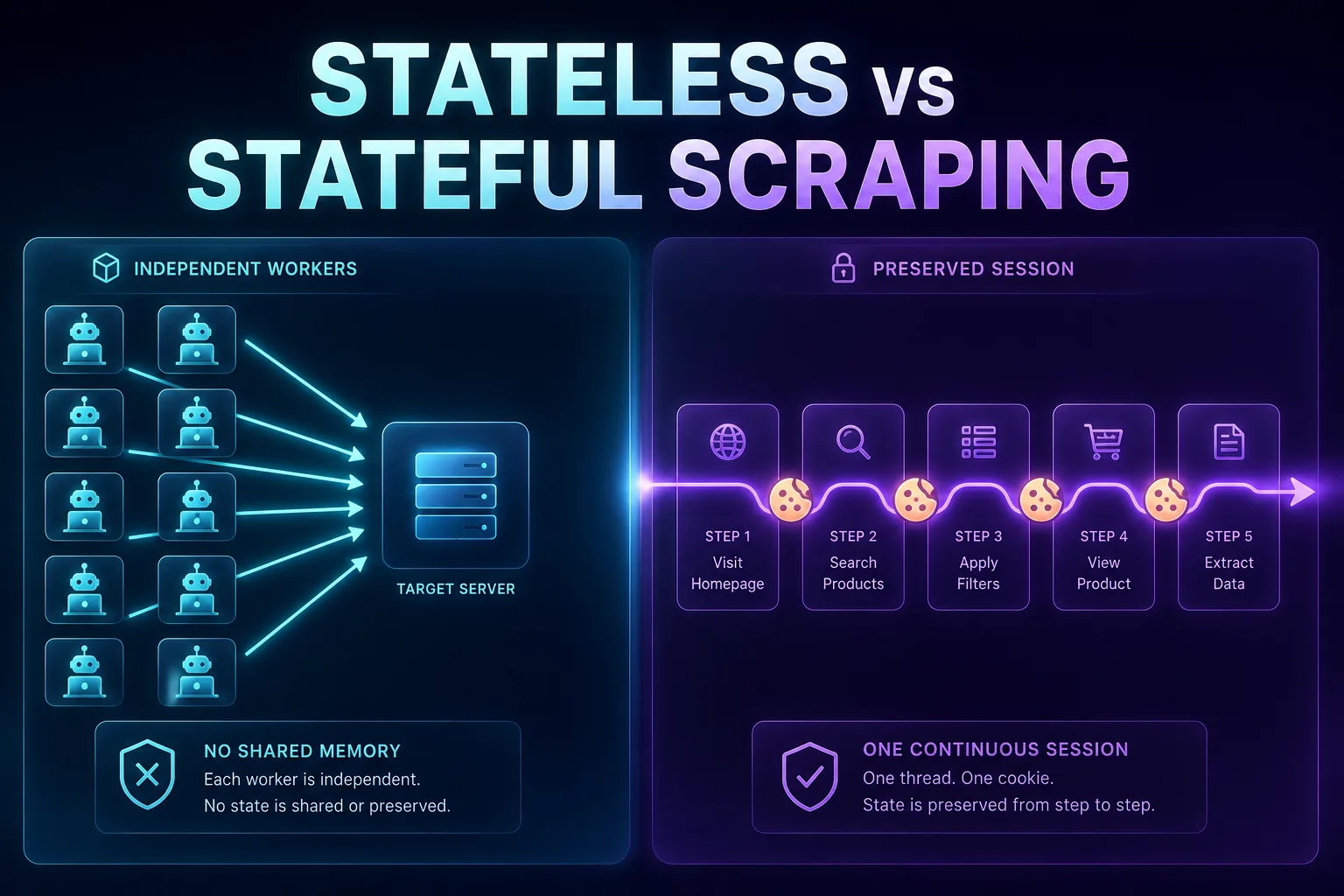
In a stateless architecture, every request carries everything it needs and leaves nothing behind. There is no shared memory between request one and request two. A worker fetches a URL, extracts data, and forgets the interaction entirely.
This is the natural shape of most public-data scraping. If you are collecting product listings, articles, business directories, or search results, each page is independent and there is no reason to remember anything. You can fire ten thousand requests across a hundred workers in any order, and the result is identical.
The practical consequences are all upside. Any worker can handle any URL, so scaling is a matter of adding workers. A failed request can simply be retried by a different worker with no cleanup. There is no session to expire, no cookie jar to corrupt, and no memory to leak. The queue is the only shared state, and queues are a solved problem.
What Stateful Scraping Means
In a stateful architecture, a sequence of requests is bound together into a session that carries context forward. Cookies from response one shape request two. An authentication token obtained at login is attached to every subsequent call. The server on the other end also remembers you, which is precisely the point.
You need this whenever the data lives behind a process rather than at a URL. Logging into an account, adding an item to a cart, stepping through a multi-page form, paginating a result set that uses a server-side cursor, or completing a checkout flow all require the site to recognise you across requests.
The cost is that a session becomes a fragile, valuable object. It has to be created, kept alive, used in order, and eventually retired. If it breaks halfway through a ten-step journey, you cannot simply retry step seven, you have to rebuild from step one. Everything about scaling and error handling gets harder.
Stateless vs Stateful: Side by Side
Here is the trade-off in one view.
| Dimension | Stateless | Stateful |
|---|---|---|
| Request independence | Fully independent | Ordered and dependent |
| Cookies and tokens | Discarded | Preserved and required |
| Proxy model | Rotating per request | Sticky session |
| Scaling | Horizontal, near-linear | Bounded by session count |
| Retry cost | Retry one request | Often rebuild the session |
| Memory footprint | Minimal | Grows with live sessions |
| Best for | Public pages at volume | Logins, carts, multi-step flows |
What "State" Actually Consists Of
It helps to be precise, because state is not one thing. A session is a bundle of several distinct items, and each can break independently.
Cookies are the obvious layer, carrying session identifiers and preferences. Authentication tokens, whether bearer tokens, JWTs, or API keys, are often held in headers or storage rather than cookies. CSRF tokens are embedded in pages and must be extracted and echoed back on the next request, which means you cannot skip a step. Server-side context is the part people forget: the cart, the search cursor, the wizard step, all held on the site’s side and keyed to your session.
Browser context matters when you use a real engine, since localStorage, sessionStorage, IndexedDB, and the in-memory JavaScript state all persist within a page or profile. And finally IP affinity, which is state you might not think of as state at all. Many sites bind a session to the address that created it, so changing IP mid-session invalidates everything else you carefully preserved.

The Proxy Dimension: Rotating vs Sticky
This is where scraping architecture and proxy configuration have to agree, and where a lot of projects quietly break.
Stateless scraping pairs naturally with rotating proxies. Because no request depends on any other, you want a fresh IP on every call to spread load and avoid per-address rate limits. Rotation is a pure benefit here with no downside.
Stateful scraping needs the opposite. If your session was created on one IP and your next request arrives from another country, most sites will invalidate the session, force re-authentication, or flag the account outright. You need sticky sessions, where the provider pins you to one exit IP for a defined window, or ISP proxies that give you a static residential address for the duration.
The rule is simple and worth stating plainly: match the proxy lifetime to the session lifetime. If your login flow takes four minutes, your sticky session must last longer than four minutes. A ten-minute sticky window with a fifteen-minute job will fail in the middle, every time, and the failure will look like a site problem rather than a configuration one.
Failure Modes and Retries
The two architectures fail in fundamentally different ways, and this is often the deciding factor in production.
In a stateless system, failure is cheap. A request times out or returns a 403, you push it back on the queue, another worker picks it up with a different IP, and nothing else is affected. Retries are safe, idempotent, and require no coordination. You can be aggressive about them.
In a stateful system, failure is expensive and contagious. If step six of a journey fails, retrying step six alone may be meaningless because the server’s idea of your position has diverged from yours. Worse, a session can become poisoned: still technically alive, but flagged, throttled, or serving degraded data. A naive retry loop keeps reusing that bad session and every result is wrong.
The practical answer is to treat sessions as disposable and to detect poisoning explicitly. Give every session a health check, retire it on the first sign of challenge pages or suspicious responses, and rebuild rather than nurse it. Our guide on handling proxy timeouts and errors covers the retry and backoff patterns that make this manageable.
Scaling and Concurrency
Stateless scrapers scale almost linearly. Workers are interchangeable, so throughput is a function of how many you run and how much your proxy pool and the target can absorb. Add machines, get more pages. There is no coordination cost.
Stateful scrapers scale by session, not by worker, and that ceiling is much lower. Each live session consumes a sticky IP, memory, and often a whole browser context, which is expensive. You also need affinity routing so that requests belonging to a session always reach the worker holding it, which introduces real distributed-systems complexity: session stores, sticky routing, and careful handling when a worker dies with sessions on it.
This is why a rough cost rule holds up well in practice: a stateful request is many times more expensive than a stateless one once you account for sticky proxies, memory, and browser overhead. That alone is a strong argument for keeping stateful work to the minimum surface that genuinely needs it.
Detection Profile: Which Looks More Suspicious?
Neither model is automatically stealthier, and the honest answer is that it depends entirely on what you are pretending to be.
Stateless scraping is less suspicious for genuinely independent visits. If you fetch a hundred unrelated product pages from a hundred different IPs with no shared cookies, that looks like a hundred separate visitors, which is unremarkable. It becomes suspicious the moment the journey implies continuity. Requesting page two of a paginated result with no cookies from a different country than page one is not a plausible human sequence.
Stateful scraping is more convincing for multi-step journeys, because carrying cookies, referers, and a stable IP is exactly what a real user does. Its weakness is that it deliberately links all your activity into one identity, so if that identity gets flagged, everything you did in the session is attributable and the account or fingerprint can be burned in one go.
The takeaway is to make your architecture match the story you are telling. A coherent journey needs coherent state, and disconnected visits should look disconnected. Our breakdown of how browser automation traffic differs from normal HTTP requests explains why these consistency signals matter so much, and how anti-bot systems detect automated browsers covers the defender side.
The Hybrid Architecture Most Teams Actually Need
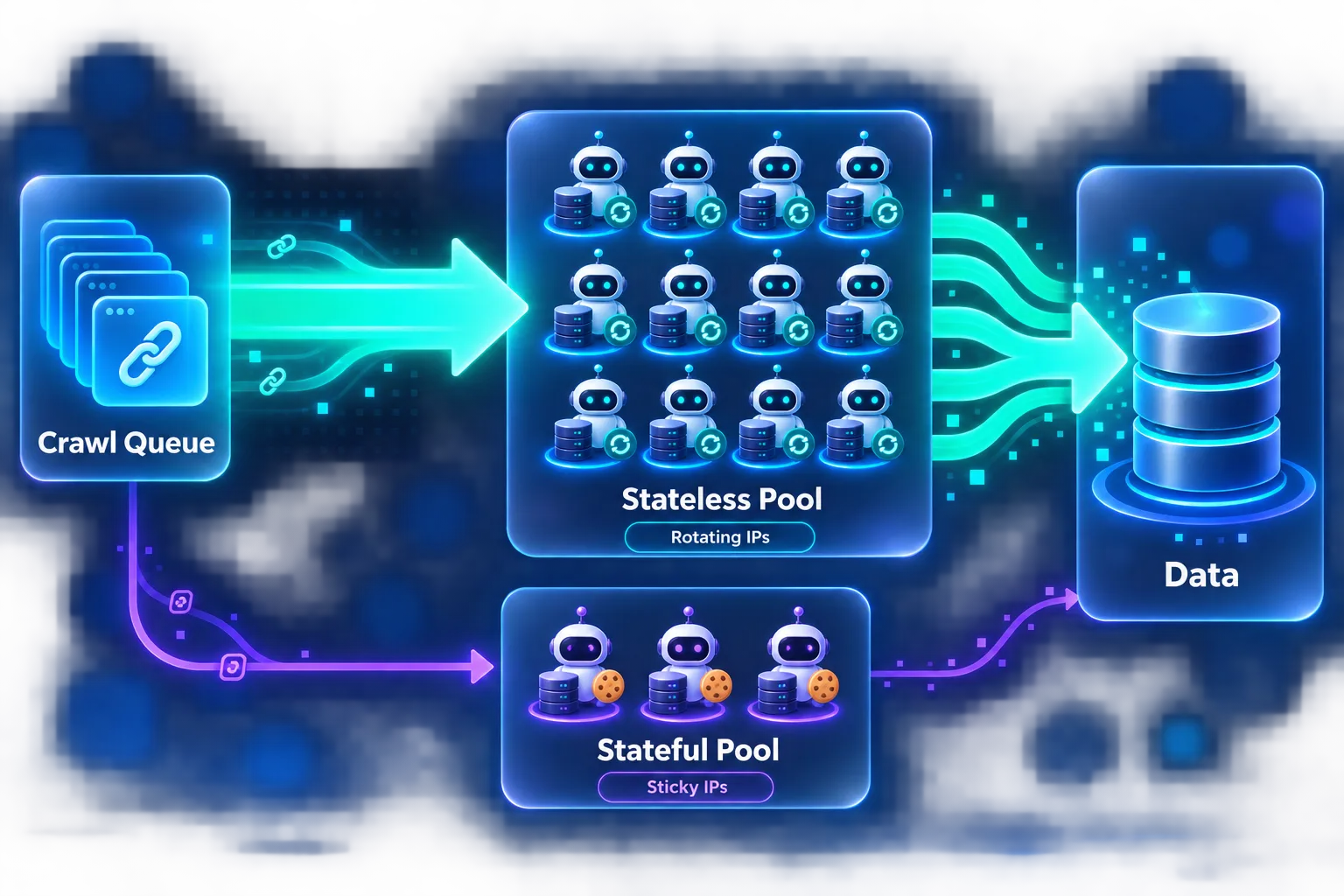
In practice the answer is rarely one or the other. Mature scrapers are stateless by default with stateful islands, and designing that deliberately is what separates a robust system from a fragile one.
The pattern works like this. The bulk of your crawling, discovery, listing pages, public detail pages, is stateless and runs on rotating proxies at high concurrency. Then you identify the narrow set of operations that genuinely require a session, such as logging in to read gated data or stepping through a checkout, and you isolate those into a separate stateful path with its own session pool and sticky proxies.
Crucially, the two paths are decoupled by a queue. The stateless crawler discovers URLs and drops the ones needing authentication into a separate queue that stateful workers drain at a much lower rate. That way a slow, expensive, fragile session pool never becomes a bottleneck on the cheap high-volume path, and a failure in one does not cascade into the other.
Implementation Patterns That Work
If you are building the stateful side, a few patterns save a lot of pain.
1Maintain a Session Pool
Pre-create and warm a pool of authenticated sessions rather than logging in on demand. Logins are the most heavily scrutinised action on most sites, so doing them rarely and reusing the result is both faster and safer.
2Externalise Session State
Store cookies, tokens, and the assigned sticky proxy in an external store such as Redis rather than in worker memory. If a worker dies, another can resume the session instead of losing it, and you can route by session ID rather than by process.
3Give Every Session a TTL and a Health Check
Sessions should expire on purpose before they expire by accident. Track age and request count, run a cheap validation request before trusting a session, and retire anything that returns a challenge or an unexpected redirect.
4Bind Proxy to Session, Not to Request
The sticky IP is part of the session object. Store them together so a session can never be resumed on a different exit address, which is one of the most common causes of mysterious mid-journey failures.
5Make Stateless the Default Path
Route to the stateful pipeline only when a URL demonstrably requires it. Every request you can serve statelessly is cheaper, faster, and more resilient. For the crawling side, see our guide to the best residential proxies for web scraping.
Common Mistakes to Avoid
These are the errors that turn a working scraper into an unreliable one.
1Rotating IPs Inside a Session
The single most common architectural bug. Your code preserves cookies perfectly while your proxy config hands out a new IP each request, so the site invalidates the session and you blame the cookies. Bind the proxy to the session.
2Making Everything Stateful Because One Thing Is
Teams often add a browser and a session pool for the entire crawl because one section needs a login. This multiplies cost and fragility across work that never needed it. Isolate the stateful part.
3Nursing Poisoned Sessions
Retrying on a session that is flagged produces confidently wrong data, which is worse than an error. Detect degradation and discard rather than retry.
4Holding Session State in Worker Memory
It works until a worker restarts, deploys, or crashes, at which point you lose every live session at once. Externalise it.
5Mismatching Sticky Window and Job Duration
If your sticky session lasts ten minutes and your flow takes twelve, you will fail intermittently in a way that is genuinely hard to debug. Measure your flow, then size the window above it.
For the queue machinery that feeds both models at scale, see our companion guide to how large-scale web crawlers manage request queues.
Frequently Asked Questions
The Bottom Line
Stateless and stateful are not competing philosophies, they are tools for different jobs. Stateless scraping gives you cheap, parallel, fault-tolerant throughput and should be your default for anything that lives at a URL. Stateful scraping gives you access to everything behind a login or a multi-step process, at a real cost in complexity, memory, and fragility.
The mistake is letting the architecture happen by accident. Decide deliberately, keep the stateful surface as small as possible, bind your proxy lifetime to your session lifetime, externalise session state, and treat sessions as disposable rather than precious.
Get those right and you end up with the hybrid most teams need: a fast stateless crawler doing the heavy lifting, with a small, well-managed stateful pipeline handling only what genuinely requires it. To get the proxy layer right, start with our guide to why web scraping needs proxies or compare providers in our proxy directory.
Keep Reading
More articles you might enjoy