IPRoyal vs Thordata (2026): A Detailed Comparison
IPRoyal vs Thordata compared: residential, mobile, ISP and datacenter pricing, traffic expiry, sticky session limits, SOCKS5, scraping APIs, and which provider fits your use case.
![IPRoyal vs Thordata ([year]): A Detailed Comparison](/_next/image?url=https%3A%2F%2Fproxyhorizon.com%2Fcdn%2Fblog-images%2Fiproyal-vs-thordata-1-mu5cuh95.webp&w=3840&q=75)
Put IPRoyal’s and Thordata’s pricing pages side by side and the decision looks finished before it starts. Thordata sells residential traffic from $2.00 per GB. IPRoyal starts at around $7. Case closed?
Not quite. The per-GB rate is the number both companies advertise, but it isn’t what you end up paying for a working setup. How long your traffic stays valid, how long one IP can hold a session, and which protocols and IP types you can actually use all change the real cost, sometimes by more than the headline gap. IPRoyal vs Thordata is a genuinely close call once you look past the rate card, and the right answer depends heavily on what you’re doing with the IPs.
This comparison covers residential, mobile, ISP, and datacenter proxies, the scraping APIs each company sells, and the hidden cost factors that decide which one is cheaper for your workload. All prices come from each provider’s official pricing pages as of September 2026. Proxy pricing changes often, so confirm current rates before you buy. We may earn a commission if you buy through links to either provider.


- Thordata is far cheaper per GB: residential starts at $2.00 against about $7 at IPRoyal, and bottoms out at $0.65 against about $1.75.
- IPRoyal’s residential traffic never expires and its sticky sessions last up to 7 days. Thordata caps sticky sessions at 90 minutes and tracks a traffic expiry date.
- For bulk scraping and data collection, Thordata usually wins on cost and has the broader scraping API lineup.
- For multi-account work, long-lived logins, and irregular usage, IPRoyal’s flexibility is often worth the higher rate.
- IPRoyal documents SOCKS5 across its products. Thordata’s pages mention HTTP(S) and don’t confirm SOCKS5.
IPRoyal vs Thordata at a Glance
| Feature | IPRoyal | Thordata |
|---|---|---|
| Residential pool (vendor claim) | 64M+ IPs | 100M+ IPs |
| Locations (vendor claim) | 195+ countries | 190+ countries |
| Residential price | About $7/GB at 1 GB, under $2/GB at 10 TB | $2.00/GB at 1 GB, $0.65/GB at 5 TB |
| Residential traffic expiry | Never expires | Expiry date tracked in dashboard |
| Max sticky session | Up to 7 days | Up to 90 minutes |
| Residential targeting | Country, state, city | Country, state, city, ASN |
| SOCKS5 | Yes, documented | Not confirmed on pricing pages |
| Mobile proxies | Dedicated devices from $117/month on 90-day plans | Per-GB, $5.00 down to $2.20 |
| Scraping tools | Web Unblocker | Web Scraper API, SERP API, Web Unlocker, Scraping Browser |
| Concurrency | Unlimited concurrent sessions | Not a published limit on pricing pages |
Residential Proxies: The Headline Gap
Residential proxies are where most buyers start, and they’re where the price difference is largest.
| Volume | IPRoyal | Thordata |
|---|---|---|
| 1 GB | About $7.00 to $7.35/GB | $2.00/GB |
| 10 GB | About $5.51/GB | $1.80/GB |
| 50 GB | Not listed at this step | $1.50/GB |
| 150 GB | Not listed at this step | $1.00/GB |
| 1 TB | Not listed at this step | $0.73/GB |
| Largest tier | About $1.75 to $1.84/GB at 10 TB | $0.65/GB at 5 TB |
IPRoyal’s own pages show slightly different figures for the same tiers depending on whether you view pay-as-you-go or subscription pricing, which is why we show a range. Either way, the pattern is clear: at 10 GB, Thordata costs roughly $18 against roughly $55 at IPRoyal. At scale, Thordata’s best rate is well under half of IPRoyal’s.
Both networks let you rotate on every request or hold a sticky IP. Thordata also offers ASN targeting on residential traffic, which is useful for narrowing to a specific carrier or ISP, though its docs warn you’ll get a 403 if no IPs are available under that ASN at the moment. Both support username and password authentication, and Thordata also supports whitelisted IPs. If you’re unsure which method to use, our guide to proxy authentication methods explains the trade-offs.
Our take: if you’re buying residential traffic purely for volume, Thordata’s pricing is hard to argue with. But read the next section before you commit, because two details can flip the maths.
The Hidden Costs: Expiry and Session Length
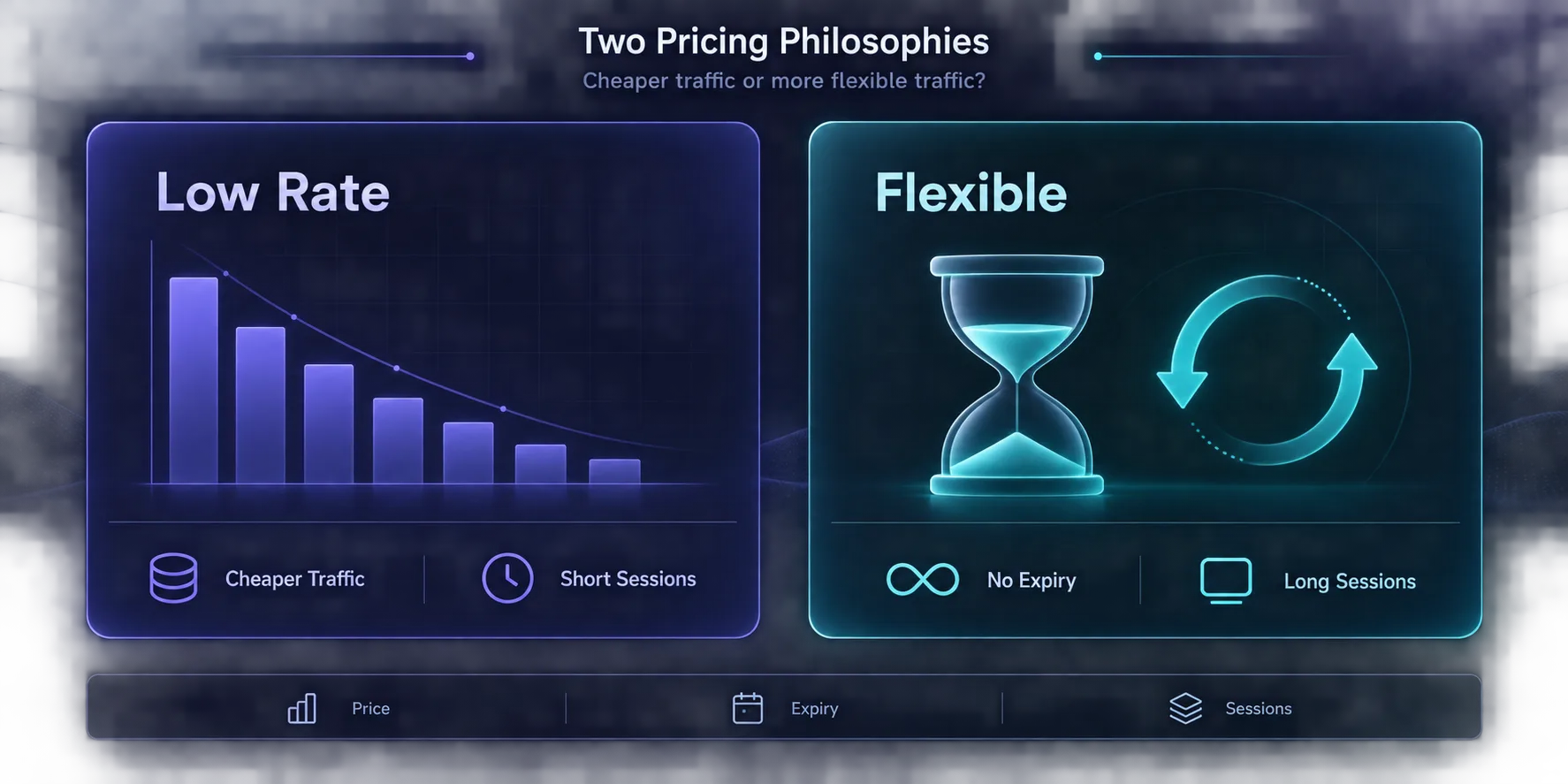
1Traffic Expiry
IPRoyal states plainly that its residential traffic never expires. Buy 50 GB, use 5 GB this month, and the other 45 GB waits until you need it.
Thordata’s quick-start documentation refers to a traffic expiry time shown in your dashboard, and the pricing pages don’t spell out the validity window. That matters because the cheapest per-GB rates come from buying large blocks. If your usage is irregular and part of that block expires unused, your effective rate climbs. A 150 GB purchase at $1.00/GB only costs $1.00/GB if you actually use all 150 GB inside the window.
2Sticky Session Length
IPRoyal lets a residential sticky session hold the same IP for up to 7 days. Thordata’s default session is 10 minutes, extendable to a maximum of 90 minutes.
For scraping, 90 minutes is plenty. Most jobs rotate constantly anyway. For account work it’s a real difference. A social media or marketplace account that stays logged in all day, but changes IP every 90 minutes, looks less like a person on a home connection. Some platforms respond with extra verification or session resets. If you manage long-lived accounts, the ability to hold an address for days is worth paying for. Our guide to how platforms detect multiple accounts covers why IP consistency matters.
3Failed Requests Cost Money Too
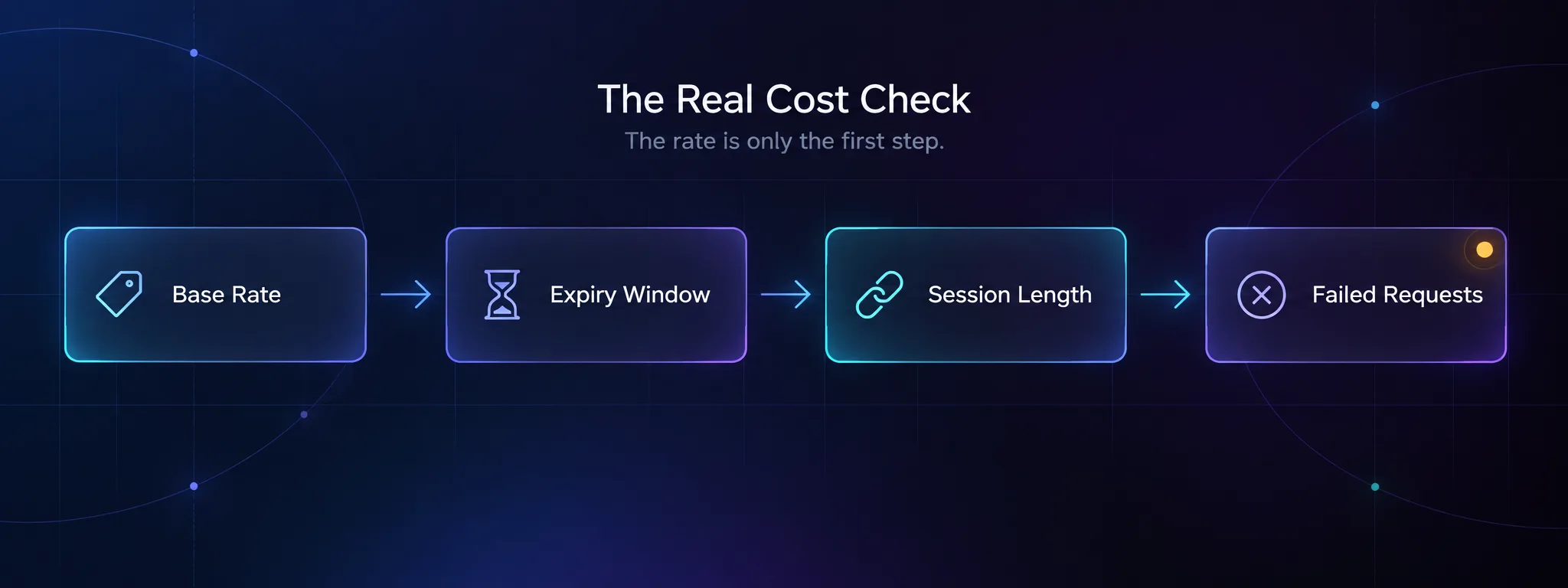
On per-GB plans you pay for bandwidth whether a request succeeds or not. A blocked page, a CAPTCHA, or a retry all consume traffic. Neither provider publishes independent success rates for your specific targets, and Thordata’s quoted average success rate is its own figure. The only reliable way to compare is to run your real target sites through both on small plans and calculate cost per successful request, not cost per GB. Our guide to testing proxy speed, latency and success rate walks through how.
Mobile Proxies: Two Different Models
This is the category where comparing prices directly is almost meaningless, because the two companies sell mobile access in completely different ways.
Thordata sells rotating mobile proxies by the gigabyte, using IPs assigned by real 4G and 5G carriers. Pricing starts at $5.00/GB, drops to $3.30/GB at 100 GB, and reaches $2.20/GB at 500 GB. Sticky sessions go up to 90 minutes. You pay only for what you use.
IPRoyal sells rotating mobile traffic and dedicated mobile proxies, where you’re the only user of that IP. Dedicated plans are priced per proxy over time: from $10.11 for 24 hours, $130 for 30 days, or $117 per month on a 90-day plan, with a daily data limit of 30 GB per proxy. IPRoyal lists 4.5M+ mobile IPs, customisable rotation, and both HTTP(S) and SOCKS5.
The right choice depends on traffic shape. Light or bursty mobile usage across many sessions favours Thordata’s pay-per-GB model. Heavy, steady traffic on one account, such as a TikTok or Instagram account that needs a trusted carrier IP all day, favours a dedicated IPRoyal device, because the flat monthly price works out far cheaper per GB once usage is high. Our roundups of the best mobile proxy providers and proxies for TikTok automation go deeper on both approaches.
Static ISP and Datacenter Proxies
| Product | IPRoyal | Thordata |
|---|---|---|
| Static ISP | $2.70/proxy for 30 days, $2.40 on 90-day plans, 24-hour passes from $1.80. Unlimited bandwidth, 31+ locations, SOCKS5 | $1.50/IP for a single IP, falling to $0.75/IP at 500+ IPs |
| Datacenter | Dedicated, one user per proxy. $1.57/proxy for 30 days, $1.39 on 90-day plans. 100 GB per monthly cycle | From $0.75/IP at volume, unlimited bandwidth |
Check before you buy: static IP prices are quoted over different plan lengths, and Thordata’s pricing pages list its static IP prices against plan durations you select at checkout. Convert both offers to cost per IP per month before comparing, or a shorter plan can look cheaper than it is.
IPRoyal’s ISP proxies stand out for supporting SOCKS5 and UDP with unlimited bandwidth, which suits long-lived accounts and tools that need non-HTTP traffic. Thordata’s static pricing is lower at volume. For more options in each category, see our guides to the best ISP proxy providers and best datacenter proxy providers.
Scraping APIs and Tools
If you’d rather not manage proxies yourself, the two companies are further apart.
Thordata sells a full data-collection stack alongside its proxies: a Web Scraper API from $1.00 per 1,000 requests, a SERP API from $0.80 per 1,000 requests, a Web Unlocker from $1.00 per 1,000 requests, and a Scraping Browser priced per GB. Its site also advertises free trial credits for these tools, including 5,000 Web Scraper API credits.
IPRoyal’s offer here is narrower: a Web Unblocker from $1.00 per 1,000 requests, built to get requests past site blocks without you managing proxies directly. Most of IPRoyal’s value is in raw proxies rather than managed scraping.
If your end goal is structured data rather than IP access, Thordata has the more complete toolkit. For a wider view of this market, compare both against our list of the best web scraping APIs.
Pool Size, Coverage and Trust
Thordata claims a 100M+ residential pool across 190+ locations. IPRoyal claims 64M+ residential IPs across 195+ countries. Treat both as marketing figures: pool numbers are self-reported, measured differently by each company, and say little about how many clean IPs are available in the specific city you need right now.
What matters more is availability in your target locations and IP quality on your target sites. Thordata’s own docs acknowledge that residential pools are dynamic and a given ASN can temporarily have no IPs. IPRoyal has a longer public track record since 2020, and on ProxyHorizon it currently has more community reviews than Thordata, which is a useful signal but not proof of better performance.
Test both in the exact countries and cities you care about before buying in bulk. You can read community reviews on the IPRoyal and Thordata directory pages.
IPRoyal: Strengths and Weaknesses
- Residential traffic never expires
- Sticky sessions last up to 7 days
- SOCKS5 documented across products
- Dedicated mobile proxies on flat monthly pricing
- ISP proxies with unlimited bandwidth and UDP support
- Unlimited concurrent sessions on residential
- Residential traffic costs several times more at low volume
- Best residential rate is still well above Thordata’s
- Narrower scraping API lineup
- Datacenter proxies capped at 100 GB per monthly cycle
Verdict
The better choice for multi-account work, long-lived sessions and irregular usage where flexibility matters more than the lowest rate.
Thordata: Strengths and Weaknesses
- Residential traffic from $2.00/GB, down to $0.65/GB
- Real 4G/5G mobile traffic sold per GB
- ASN targeting on residential proxies
- Full scraping stack: Scraper API, SERP API, Unlocker, Scraping Browser
- Low static and datacenter IP pricing at volume
- Sticky sessions max out at 90 minutes
- Residential traffic has an expiry date
- SOCKS5 support not confirmed on pricing pages
- Younger network with fewer independent reviews
Verdict
The better choice for scraping and data collection at volume, where cost per GB and managed tooling matter most.
Which Should You Choose?
| Your situation | Better pick | Why |
|---|---|---|
| High-volume web scraping | Thordata | Much lower residential cost per GB |
| SERP tracking or structured data | Thordata | Dedicated SERP and Scraper APIs |
| Accounts that stay logged in for days | IPRoyal | Sticky sessions up to 7 days |
| Irregular or seasonal usage | IPRoyal | Residential traffic never expires |
| Light, bursty mobile traffic | Thordata | Pay per GB, no device rental |
| Heavy traffic on one mobile account | IPRoyal | Dedicated mobile proxy on a flat monthly price |
| Tools that need SOCKS5 or UDP | IPRoyal | Documented SOCKS5, UDP on ISP proxies |
| Tight budget, testing a new project | Thordata | $2.00 entry price and free trial credits |
1Choose IPRoyal If
You run accounts rather than crawlers. Social media managers, e-commerce sellers, and anyone using antidetect browsers will get more from long sticky sessions, non-expiring traffic, and SOCKS5 than from a lower per-GB rate. It’s also the safer pick if your usage comes in bursts, because nothing you buy goes to waste. See how it stacks up against other providers in IPRoyal vs Decodo and IPRoyal vs Oxylabs.
2Choose Thordata If
You collect data at volume and use most of what you buy. Scraping, price monitoring, SERP tracking, and market research all rotate IPs constantly, so 90-minute sessions aren’t a limitation and the lower rate compounds quickly. Its scraping APIs also give you a path to managed collection without switching vendors.
Common Mistakes When Comparing Proxy Providers
1Comparing Only the Price Per GB
The rate card ignores expiry, session length, and failed requests. A cheaper GB that expires unused or gets blocked more often on your targets can cost more than an expensive one. Compare cost per successful request on your real sites.
2Buying a Large Block Before Testing
Volume discounts are tempting, but they lock you in before you know how either network performs on your targets. Start with the smallest plan on both, run the same test, then scale the winner.
3Comparing Static IP Prices Across Different Plan Lengths
A 24-hour or 7-day price can look far cheaper than a 30-day price. Normalise every static offer to a monthly cost per IP before deciding.
4Ignoring Protocol Requirements
Some automation tools, antidetect browsers, and messaging apps expect SOCKS5. Confirm protocol support for the exact product you’re buying before you pay, not after setup fails.
Frequently Asked Questions
The Verdict
There isn’t a single winner here, and anyone who tells you otherwise is only looking at one number. Thordata is the better deal for high-volume data collection, where you use what you buy, rotate constantly, and benefit from its scraping APIs. IPRoyal is the better deal for account management and irregular usage, where 7-day sessions, non-expiring traffic, SOCKS5, and dedicated mobile devices matter more than the per-GB rate.
The fastest way to decide: buy the smallest residential plan from each, run your real targets through both for a day, and divide what you spent by the number of successful requests. That single figure will tell you more than any comparison, including this one. For more options, browse the full proxy directory or see our best residential proxy providers.
![OpenClaw vs Hermes Agent: Which Is Better? ([year])](/_next/image?url=https%3A%2F%2Fproxyhorizon.com%2Fcdn%2Fblog-images%2Fopenclaw-vs-hermes-agent-1-mu16j93j.webp&w=3840&q=75)
![Grok Bot vs OpenClaw vs Hermes vs n8n ([year])](/_next/image?url=https%3A%2F%2Fproxyhorizon.com%2Fcdn%2Fblog-images%2Fgrok-bot-vs-openclaw-vs-hermes-vs-n8n-1-mtzmbk5w.webp&w=3840&q=75)
![Grok Bot vs Claude Cowork vs ChatGPT Work ([year])](/_next/image?url=https%3A%2F%2Fproxyhorizon.com%2Fcdn%2Fblog-images%2Fgrok-bot-vs-claude-cowork-vs-chatgpt-work-1-mtzmbgoq.webp&w=3840&q=75)