Best Cloro.dev Alternatives for Search API and AI Agents (2026)
Nine Cloro.dev alternatives for tracking what ChatGPT, Perplexity and Google’s AI features say, or for feeding AI agents live web results. Coverage table, real costs, and when Cloro still wins.
![Best Cloro.dev Alternatives for Search API and AI Agents ([year])](/_next/image?url=https%3A%2F%2Fproxyhorizon.com%2Fcdn%2Fblog-images%2Fbest-cloro-alternatives-1-muhiipeo.webp&w=3840&q=75)
Cloro does something most search APIs can’t. It asks ChatGPT, Perplexity and Gemini a question, then hands you their answers as clean JSON.
So why look for a Cloro alternative? Usually for one of three reasons. The bill grows faster than your prompt list. You need data Cloro doesn’t sell. Or you’re building an agent that needs web pages, not AI answers.
Each reason points to a different tool. Some cost a fraction of Cloro per answer. One isn’t a scraper at all, and it answers a question no scraper can.
First, though, there’s a difference in how these tools collect answers. It decides whether your data matches what customers see, and most buyers never ask about it.
- SearchApi is the closest like-for-like Cloro alternative, with ChatGPT, Gemini, Copilot, Perplexity and Google’s AI features under one key.
- Bright Data and DataForSEO cost far less per ChatGPT answer.
- Scraping the ChatGPT app and calling the OpenAI API give you different answers, so check which one a tool uses.
- For grounding AI agents, Tavily, Exa and Perplexity’s Search API fit better than any answer scraper.
- Cloro still stands out for one consistent schema across its engines and US state targeting.
What Cloro Does Well, and Why People Look Around
Credit where it’s due. Cloro covers a lot of ground in one API: ChatGPT, Perplexity, Gemini, Copilot, Grok, Google AI Mode, AI Overviews, Google Search and Google News.
Every answer comes back as JSON with its sources and citations. You can target any country, and even a US state for ChatGPT, Copilot, Perplexity, Gemini and Grok. An MCP server lets agents in Claude or Cursor call it directly.
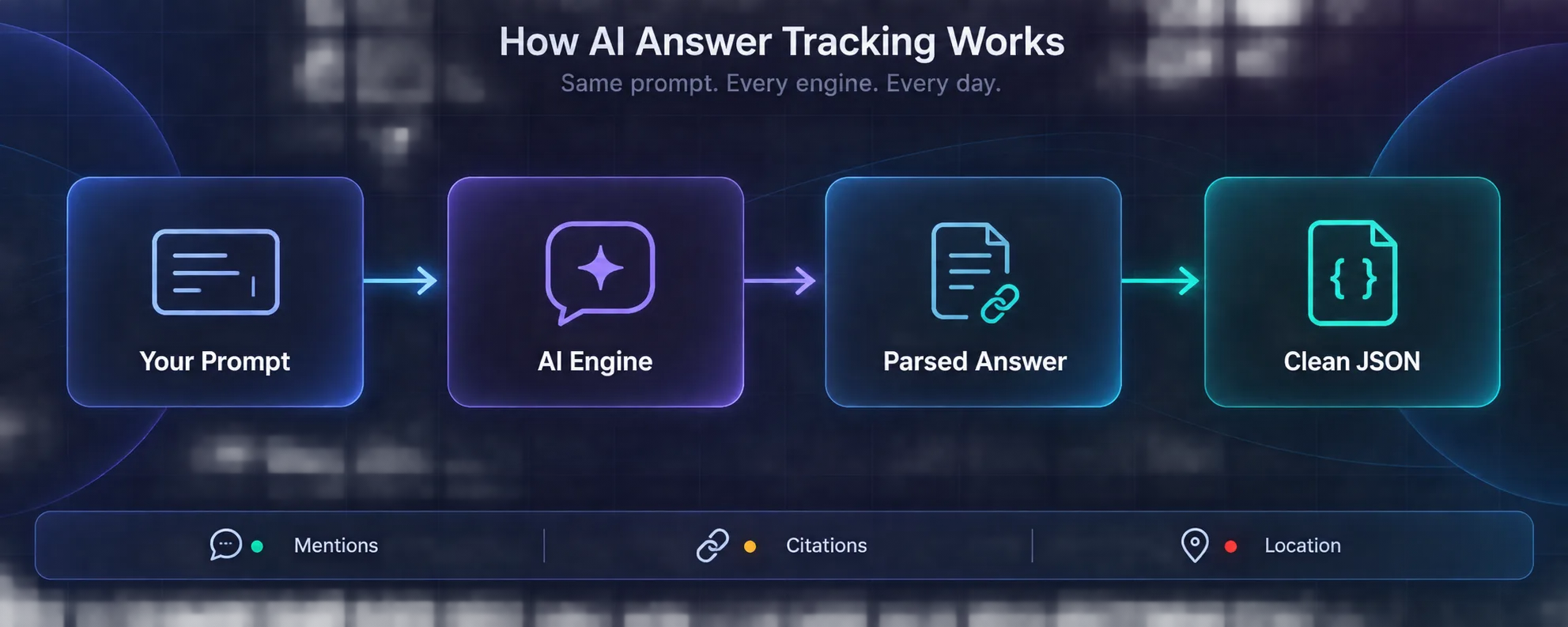
Pricing runs on credits. A Google search costs 3, Perplexity and Gemini cost 4, an AI Overview costs 5 and a full ChatGPT answer costs 7. The free plan includes 500 credits a month, and $30 buys 37,500.
So why do people look elsewhere? Three reasons come up again and again.
- Price at volume. Seven credits per ChatGPT answer adds up once you track thousands of prompts a day.
- Speed. Cloro drives the real apps, so answers take 30 to 45 seconds on average. That’s fine for reports and slow for an agent in a live chat.
- Different data. Some teams want a ready-made database of AI prompts, or full page content for an agent to read. Cloro returns live answers and results pages instead.
App Answers vs API Answers: The Question Most Buyers Skip
Here’s the difference from the top of this guide. There are two ways to get a ChatGPT answer through an API, and they don’t return the same thing.
The first is to scrape the ChatGPT app, the way a customer sees it. Cloro, SearchApi, Bright Data and Oxylabs work this way, and so does DataForSEO’s LLM Scraper.
The second is to call the model’s official API. DataForSEO’s LLM Responses API does this, and so does any tool built straight on the OpenAI API.
Why does it matter? The app can search the web, show shopping cards and adjust to location. A plain API call returns what the model says on its own. Cloro puts it bluntly: API responses are nothing like the UI.
In plain English: if you want to know what your customers see, you need app answers. If you want to test what a model knows, API answers are cheaper and fine.
Coverage is the next filter. Here’s which AI surfaces each answer API documents.
| AI surface | Cloro | SearchApi | Bright Data | Oxylabs | DataForSEO | SerpApi |
|---|---|---|---|---|---|---|
| ChatGPT | ✓ | ✓ | ✓ | ✓ | ✓ | Not listed |
| Perplexity | ✓ | ✓ | ✓ | ✓ | API only | Not listed |
| Gemini | ✓ | ✓ | ✓ | ✓ | ✓ | Not listed |
| Copilot | ✓ | ✓ | ✓ | Not listed | Not listed | ✓ |
| Grok | Paused | Not listed | ✓ | Not listed | Not listed | Not listed |
| Google AI Mode | ✓ | ✓ | ✓ | ✓ | ✓ | ✓ |
| AI Overviews | ✓ | ✓ | Not listed | ✓ | ✓ | ✓ |
A tick means the vendor documents it. Not listed means we didn’t find it in the vendor’s public docs in September 2026. Cloro’s pricing page showed Grok as temporarily unavailable.
How We Picked These Alternatives
We compared each vendor’s official pricing pages and documentation in September 2026. We didn’t run a paid accuracy test, so treat prices as a starting point and check a sample of answers yourself.
- Which AI engines and Google surfaces it covers
- Whether it scrapes the app or calls the model’s API
- Real cost at 3,000 and 12,000 answers a month
- Speed, location targeting and output detail
- Fit for AI agents that need live web results
Cloro, Bright Data and Oxylabs are affiliate partners, so we may earn a commission if you sign up through our links. That’s also why we’re upfront about where the alternatives beat Cloro. No brand paid for its spot on this list.
The 9 Best Cloro Alternatives in 2026
The first five track AI answers the way Cloro does. The last four are search APIs for agents that need live web results instead.
1SearchApi
SearchApi is the closest like-for-like Cloro alternative. One key covers ChatGPT, Gemini, Bing Copilot, Perplexity, Google AI Mode and AI Overviews, plus Google Search and more than 40 other engines.
ChatGPT answers come back as structured JSON, with reference links and inline citations mapped to the claims they support. Geo-targeting is built in.
AI engines bill like any other search on its plans. The $40 Developer plan includes 10,000 searches, or $4 per 1,000. The $100 Production plan includes 35,000, plus legal protection worth up to $2 million.
The catch: there’s no Grok, and you can only use about 20% of your monthly searches in any one hour. The free trial is small, too, at 100 requests.
2Bright Data
Bright Data is the best managed option for a low price per answer with no subscription. It runs separate scrapers for ChatGPT, Perplexity, Gemini, Grok, Microsoft Copilot and Google AI Mode.
Each one returns the prompt, the answer as text and HTML, and its citations and links, with country targeting. Pay-as-you-go costs $1.50 per 1,000 records, and most of these scrapers include 5,000 free records a month.
Results arrive as JSON, NDJSON or CSV, by API, webhook or straight into cloud storage. There’s an MCP server for agents, too.
The catch: each engine is its own scraper, so you stitch the results together yourself. We also didn’t find a dedicated AI Overviews scraper.
3DataForSEO
DataForSEO is the cheapest way to track ChatGPT and Gemini answers, as long as you can wait. Its LLM Scraper reads the real apps for $0.0012 per answer in the standard queue, which returns within 45 minutes.
Need it faster? Priority costs $0.0024 with a five-minute turnaround, and live results cost $0.004 in about 90 seconds. Google AI Mode has its own endpoint, and AI Overviews come with its normal Google results.
Then there’s the tool from the top of this guide that isn’t a scraper at all. The LLM Mentions API queries DataForSEO’s own database of AI prompts and answers. You can see which prompts already mention your brand without guessing them first.
It costs $0.10 per request plus $0.001 per row returned.
The catch: there’s no Copilot or Grok, and Perplexity comes only through its official API. The minimum deposit is $50, and the tools are spread across several endpoints.
4Oxylabs
Oxylabs suits teams that want AI answer data from a big proxy vendor. Its Web Scraper API has targets for ChatGPT, including its ads and shopping results, plus Perplexity, Gemini, Google AI Mode and AI Overviews.
Requests run on a network of more than 175 million residential IPs, with country targeting. You pay per successful result, plans start at $49 a month, and the free trial covers 2,000 results.
For agents, Oxylabs AI Studio adds prompt-driven search and scraping apps. We cover those in our guide to Firecrawl alternatives.
The catch: we didn’t find a published per-result rate for the AI targets, and there’s no Copilot or Grok target. Use the trial to confirm your real cost.
5SerpApi
SerpApi is the pick when Google’s and Microsoft’s AI features are what you track. It has dedicated APIs for Google AI Overviews, Google AI Mode and Bing Copilot, plus Google Search and dozens of other engines.
One trap to know: Google sometimes loads an AI Overview separately, so SerpApi returns a token you must use within four minutes. Our SERP API guide covers this and more.
The free plan gives you 250 searches a month, and $75 buys 5,000. Plans from $150 up include a U.S. Legal Shield worth up to $2 million.
The catch: there’s no ChatGPT, Perplexity or Gemini, and it costs more per search than most alternatives here.
6Tavily
Tavily is the best default search API for AI agents. One service covers search, page extraction, site mapping and crawling, and its results are shaped for a model to read.
Nebius agreed to buy Tavily in February 2026 for $275 million, and Tavily still runs under its own brand. Every account gets 1,000 free credits a month, and pay-as-you-go costs $0.008 per credit.
A basic search costs 1 credit and an advanced one costs 2. Extraction costs 1 credit per five pages. So a basic search works out to $8 per 1,000 at pay-as-you-go rates.
The catch: it won’t tell you what ChatGPT says, and it doesn’t return Google’s rankings. It’s built for agents that need facts, not for visibility tracking.
7Exa
Exa is the pick for research-heavy agents. It runs its own search engine built for AI and finds pages by meaning rather than exact keywords. It can also return their contents in the same call.
Standard search costs $7 per 1,000 requests for up to 10 results. Page contents cost $1 per 1,000 pages for each content type, and deep search costs $12 per 1,000. New accounts get $10 of free credit.
An Answer endpoint, at $5 per 1,000, returns a cited answer instead of a list of links.
The catch: costs stack up once you add contents and deep search. And like Tavily, it isn’t a window into Google’s rankings or ChatGPT’s answers.
8Perplexity Search API
Perplexity’s Search API gives your agent ranked web results from Perplexity’s own index, with no AI answer on top. You can filter by domain, language, country and recency.
It costs $5 per 1,000 requests, or $1 for the faster variant. Want a written answer with citations instead? The Sonar models add request fees of $5 to $14 per 1,000, plus token costs.
Here’s the subtle part. This API doesn’t show you what the Perplexity app tells your customers. For that, you still need an app scraper like Cloro, SearchApi or Bright Data.
The catch: you prepay for credits, and results come from Perplexity’s index, so they won’t match Google’s.
9Brave Search API
Brave Search API is the pick when you want web results with no dependence on Google or Bing. It queries Brave’s own index of more than 30 billion pages.
Search costs $5 per 1,000 requests, and every account gets $5 of free credit each month, which covers about 1,000 searches. An LLM Context endpoint returns results shaped for grounding a model.
No scraping sits between you and the data, and no lawsuit hangs over the source.
The catch: results won’t match Google’s rankings. Storing results to train AI also needs a plan that grants storage rights.
What Tracking 100 Prompts a Day Really Costs
Credits and plans hide the real number. So here are two workloads. The first is 100 prompts a day in ChatGPT, or 3,000 answers a month.
The second runs the same prompts across ChatGPT, Perplexity, Gemini and Google AI Mode. That’s 12,000 answers a month.
| API | 3,000 ChatGPT answers | 12,000 answers, four engines | What drives it |
|---|---|---|---|
| Cloro | $30 plan (21,000 credits) | $100 plan (57,000 credits) | 7 credits per ChatGPT answer, 4 for the others |
| SearchApi | $40 plan | $100 plan | Each answer counts as one search |
| Bright Data | About $4.50 | About $18 | $1.50 per 1,000 records |
| DataForSEO | About $3.60 | About $11, plus Perplexity API fees | Standard queue, $50 minimum deposit |
| Oxylabs | From the $49 plan | From the $49 plan | No public rate for AI targets |
Prices come from each vendor’s pricing page in September 2026, before discounts and free tiers.
Cloro isn’t the cheapest here, and we won’t pretend otherwise. Bright Data and DataForSEO cost a fraction as much per answer.
What Cloro’s price buys is one consistent schema across its engines, answers in under a minute and US state targeting. At 12,000 answers a month, the gap is about $80. At 100,000 ChatGPT answers, it grows to a few hundred dollars a month.
Our take: for a few hundred prompts, choose on coverage and data quality, not price. Past tens of thousands of answers a month, run a parallel test with DataForSEO or Bright Data and compare the citations.
Search API or Answer API? Choosing for AI Agents
Cloro’s MCP server means an agent can ask ChatGPT what it thinks. But most agents don’t need that. They need facts from fresh web pages.
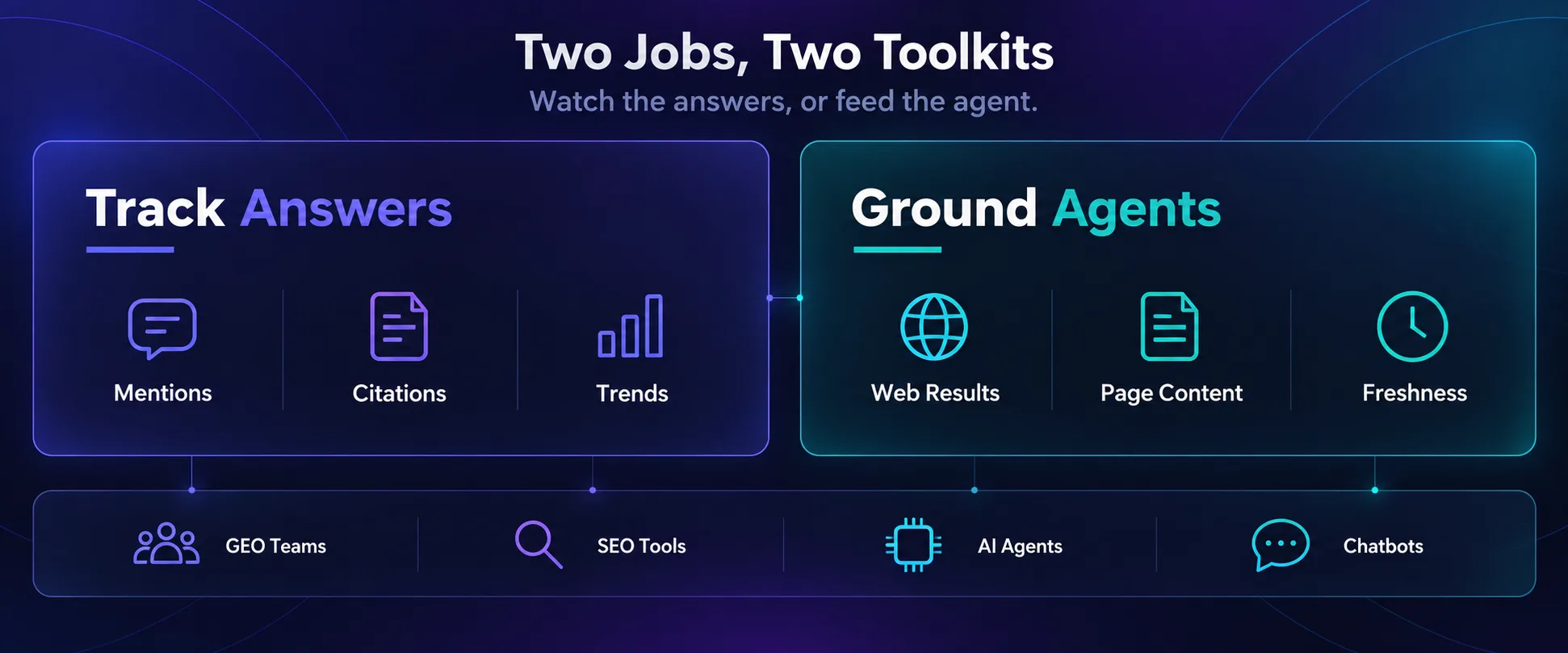
| What your agent needs | Best fit | Why |
|---|---|---|
| Fresh pages to read and quote | Tavily, Exa | Results and page content in one call |
| Google’s actual results | Serper, SerpApi, DataForSEO | They copy the real results page |
| Web results without Google | Brave, Perplexity Search API | Independent indexes, simple pricing |
| What AI engines say about a topic | Cloro, SearchApi | They capture the answers people see |
Speed matters here, too. Serper says most of its Google requests return in one to two seconds, at about $1 per 1,000 queries. An answer scraper that takes 30 seconds is fine for a nightly report and painful inside a live chat.
Building agents that read whole sites? Our guide to AI research and data extraction tools goes deeper.
When Cloro Is Still the Right Choice
An honest alternatives list shouldn’t pretend the original is bad. Cloro is still the better pick in four situations.
- You want many AI engines in one schema, from ChatGPT to Copilot and Google AI Mode, without stitching vendors together.
- You need US state targeting, which we didn’t find documented by the alternatives here.
- Your agent should check AI answers itself through an MCP server.
- You want one bill and one support team for all of it.
How to Choose the Right Cloro Alternative
1Are You Tracking Answers or Feeding an Agent?
Tracking points to SearchApi, Bright Data, DataForSEO, Oxylabs or SerpApi. Feeding an agent points to Tavily, Exa, Brave or Perplexity’s Search API. Few teams need both from one vendor.
2Do You Need the App’s Answer or the Model’s?
For brand visibility, you need the app, because that’s what customers see. For testing what a model knows about your product, the official API is cheaper and easier to control.
3How Fresh Does the Data Need to Be?
Daily brand reports can wait in a queue, which is where DataForSEO’s lowest prices live. Live dashboards and agents can’t wait, so budget for live modes or a faster tool.
4Which Engines Matter to Your Audience?
Check where your customers ask questions before you pay for every engine. For many brands, ChatGPT, Google’s AI features and Perplexity cover most of the picture.
Mistakes That Skew AI Visibility Data
1Running Each Prompt Only Once
AI answers change between runs, even with the same prompt. One sample can show your brand today and drop it tomorrow. Run important prompts several times and track the share of answers that mention you.
2Ignoring Location
Answers shift with country, which is why Cloro even supports US states. A prompt checked from the US tells you little about the UK. Our guide to SEO monitoring explains why location changes results.
3Counting Mentions but Not Citations
A mention is nice. A citation is a link that can send traffic. Track which of your pages get cited, and you’ll see which content AI engines rely on.
Frequently Asked Questions
Choose by Job, Then by Price
The right Cloro alternative depends on the job, not the brand name.
For tracking AI answers, SearchApi is the closest match, while Bright Data and DataForSEO cost far less per answer. For agents that need live web results, Tavily is the best default, with Exa, Brave and Perplexity close behind.
Your next step: pick 20 prompts that matter to your business. Run them through Cloro’s free 500 credits and one alternative’s free tier on the same day, then compare which sources each one cites. Building your own tracker instead? You’ll need proxies, so compare providers in our proxy directory.
![Best Firecrawl Alternatives to Try in [year]](/_next/image?url=https%3A%2F%2Fproxyhorizon.com%2Fcdn%2Fblog-images%2Fbest-firecrawl-alternatives-1-muhiimue.webp&w=3840&q=75)
![The Best Data Extraction APIs to Try in [year]](/_next/image?url=https%3A%2F%2Fproxyhorizon.com%2Fcdn%2Fblog-images%2Fbest-data-extraction-apis-1-mufdevwh.webp&w=3840&q=75)
![Best SERP APIs ([year]): Compared for Accuracy, Pricing & AI](/_next/image?url=https%3A%2F%2Fproxyhorizon.com%2Fcdn%2Fblog-images%2Fbest-serp-apis-1-mufdet7y.webp&w=3840&q=75)